
Sound Waves and Detection
SOUND WAVES are examples of LONGITUDINAL WAVES.
These are waves where the OSCILLATIONS are PARALLEL to the direction of ENERGY TRANSFER.
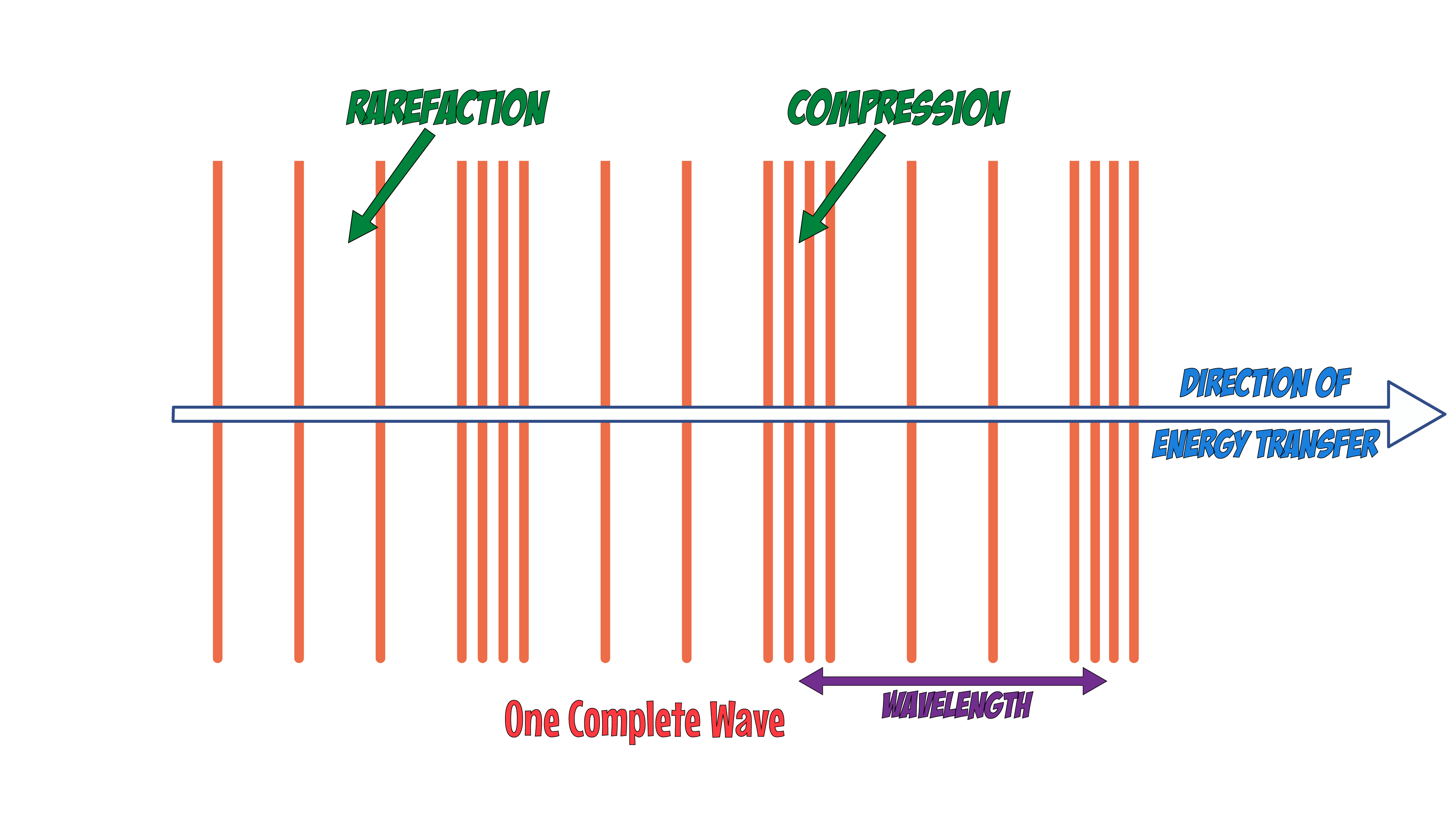
- COMPRESSION: The region where the particles of the medium are CLOSEST to each other.
- RAREFACTION: The opposite of compression. It's the part where the particles are SPREAD APART.
- WAVELENGTH: The distance between CONSECUTIVE COMPRESSIONS or between CONSECUTIVE RAREFACTIONS.
SOUND WAVES are waves that require a MEDIUM (like air, liquids, or solids) to travel through.
These waves cause the particles of the MEDIUM to VIBRATE back and forth in the direction of ENERGY TRANSFER.
Human Hearing
Inside the EAR, sound waves strike the EAR DRUM, causing it to VIBRATE.

The vibration is then TRANSFERRED to other SOLID auditory components before being transferred into electrical signals.
The conversion of SOUND WAVES to vibrations of SOLIDS (the ear drum and auditory components) only works over a LIMITED RANGE OF FREQUENCIES.
This restricts the limits of human hearing, meaning humans can only hear sound wave frequencies ranging from 20 Hz to 20 kHz.
Outside this range, the physical properties of sound waves and human ear mechanics do not align to produce audible sound.