Required Practical: Reflection and Refraction
1. Reflection of Light
This experiment investigates light reflecting off a smooth surface such as a mirror, and aims to demonstrate the LAW OF REFLECTION.

Apparatus:
- Ray box (light source)
- Flat mirror
- Protractor
- Ruler
- Pencil
- Paper
Method:
Place a piece of paper on the table.
Using a RULER, draw a straight solid LINE in the middle of the paper.
Use a PROTRACTOR to draw a dotted line at a 90° angle that bisects the line. This line serves as the NORMAL to the mirror’s surface.
Position the mirror along the solid line, aligning it with the markings on the paper.
Switch on a RAY BOX and aim a beam of light towards the point where the two lines cross, which should be at the edge of the mirror.
Mark the position of the light beam just after it exits the ray box and the position where it REFLECTS off the mirror.
After turning off the ray box and removing the mirror, use a ruler to join these two marked positions back to the point where the drawn lines intersect.
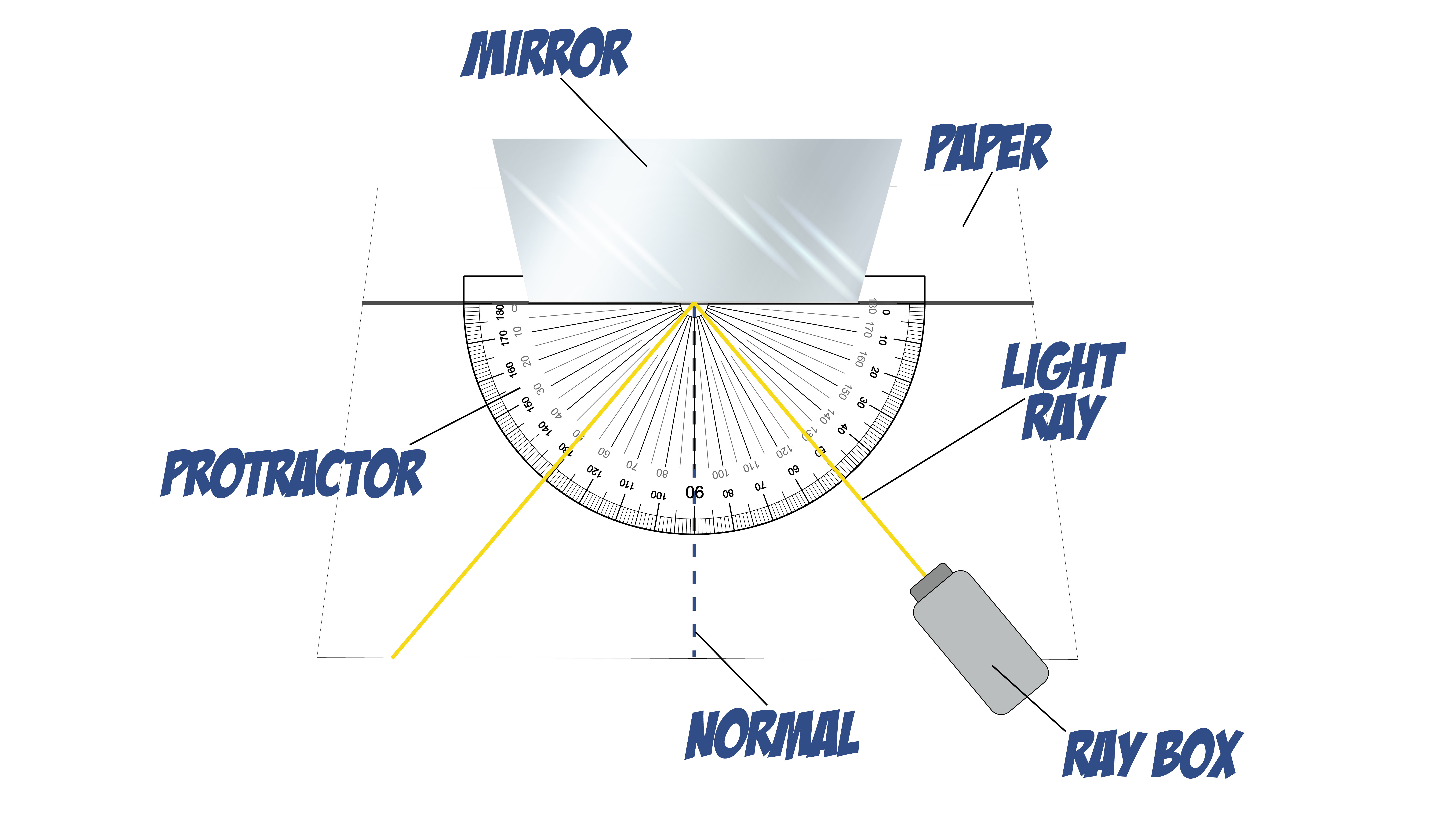
Use the PROTRACTOR to measure the angles relative to the normal (90° line). The angle of the incoming ray is the ANGLE OF INCIDENCE, and the angle of the reflected ray is the ANGLE OF REFLECTION.
REPEAT the procedure several times with the beam of light aimed at different angles to ensure reliability of the results.
The results should show that the ANGLE OF INCIDENCE = ANGLE OF REFLECTION.
2. Refraction of Light
This experiment demonstrates REFRACTION - the bending of light as it passes through a GLASS BLOCK.
The aim is to investigate how the angle of INCIDENCE affects the angle of REFRACTION.
Apparatus:
- Glass block
- Ray box or optical pins
- Plain paper
- Pencil
- Protractor
- Ruler
Method:
Place the glass block on a piece of paper and draw around it to outline its shape.
Position the RAY BOX so that it shines a light ray through the glass block at an initial angle of incidence.
Mark the point where the light ray enters the glass block (point of incidence).
Mark the point where the light ray exits the glass block (point of emergence).
Draw straight lines from the ray box to the point of incidence and from the point of emergence outward.
Draw a NORMAL LINE (a line at 90 degrees) to the surface at the point where the light enters and exits the block.
Use a PROTRACTOR to measure the angle of incidence (the angle between the incoming ray and the normal) and the angle of refraction (the angle between the refracted ray and the normal).
Adjust the angle of incidence in 10-degree intervals, starting from 10 degrees up to 70 degrees.
For each setting, REPEAT the marking and measuring steps.
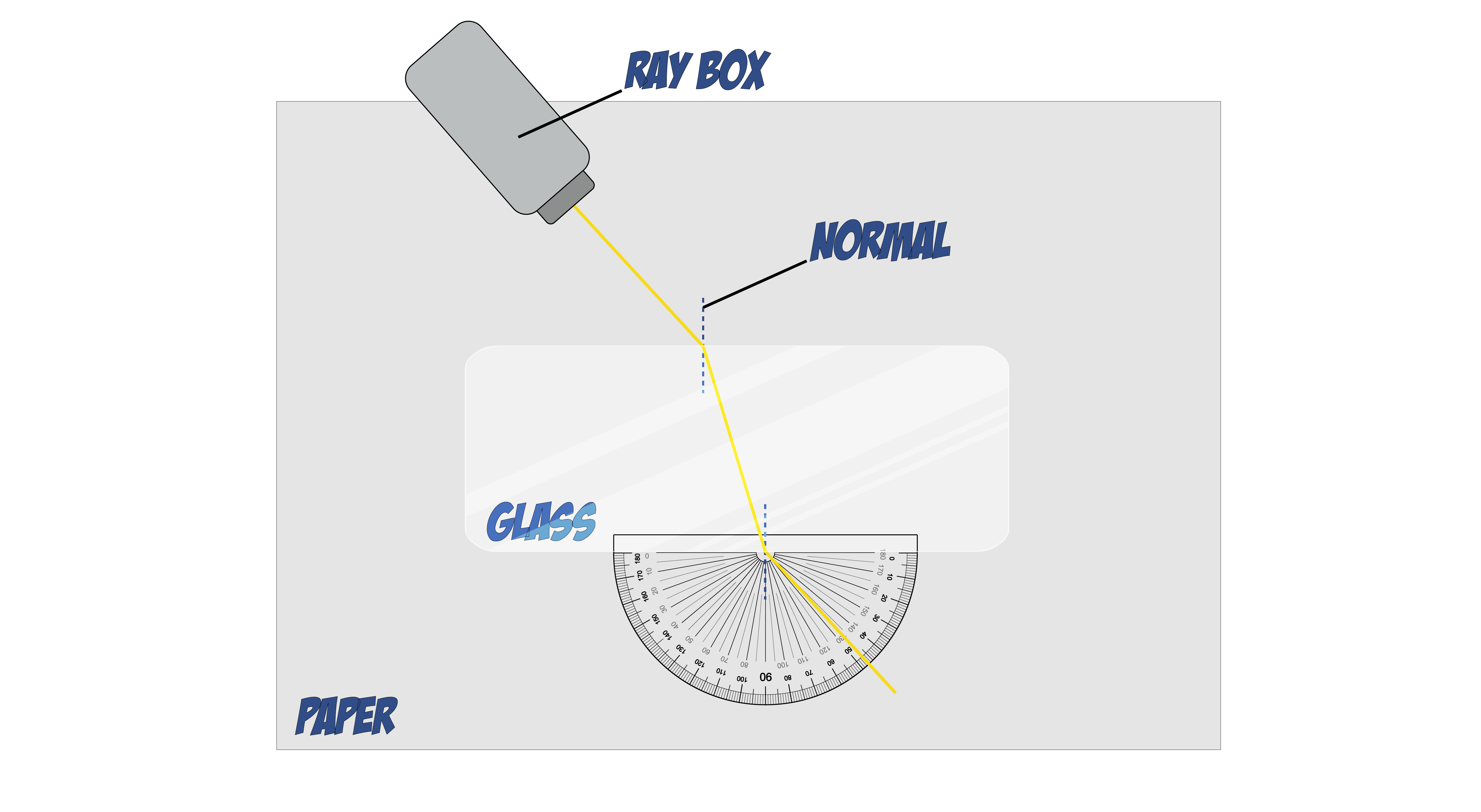
Analyse how the angle of refraction changes with varying angles of incidence.
You will find that as the ANGLE OF INCIDENCE INCREASES, the ANGLE OF REFRACTION CHANGES.