
Required Practical: Electrolysis
This experiment is used to understand and observe the reactions occurring during the ELECTROLYSIS of various aqueous solutions using INERT ELECTRODES.
Equipment and Materials:
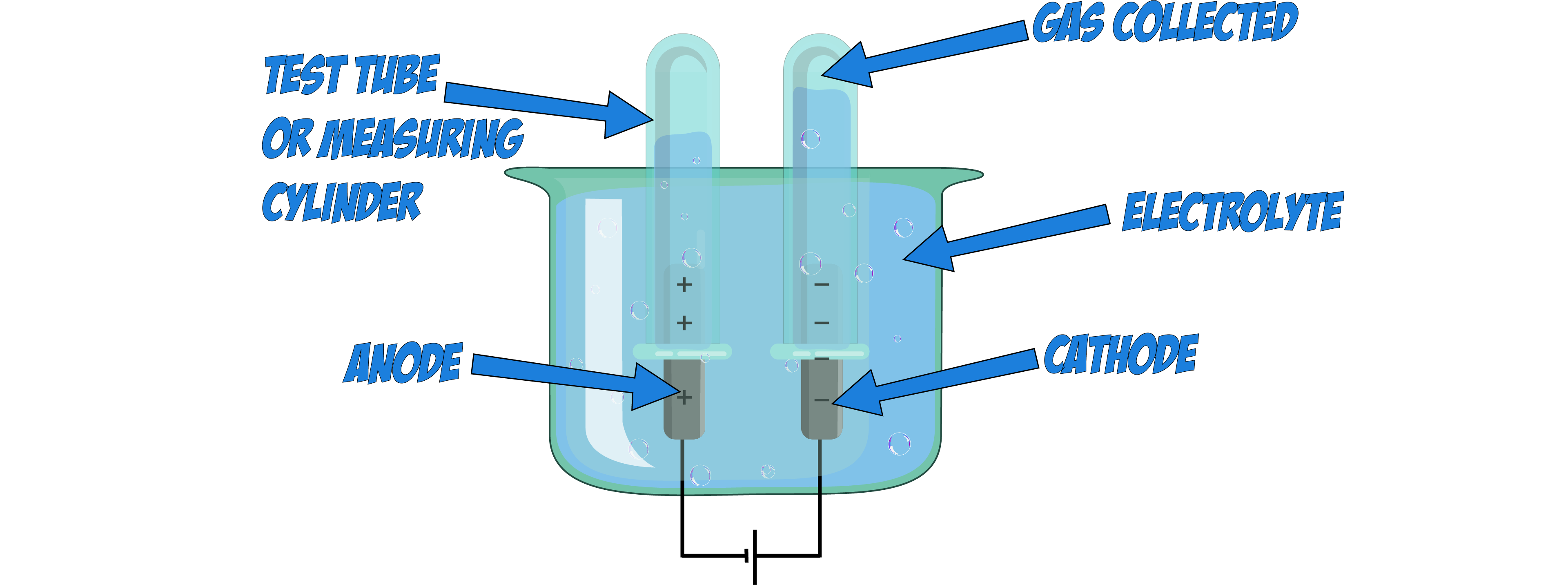
- TEST TUBES OR MEASURING CYLINDERS: To collect and measure gases produced at the electrodes.
- ELECTROLYTE SOLUTIONS: Aqueous solutions that will undergo electrolysis.
- BEAKER: To hold the electrolyte during electrolysis.
- GRAPHITE ELECTRODES: Inert electrodes that conduct electricity without reacting.
- POWER SUPPLY: To provide a controlled electric current.
Method:
- Choose an ELECTROLYTE.
- Pour out a sample of the electrolyte into the beaker.
- Immerse two INERT electrodes into the solution and place an INVERTED TEST TUBE over each electrode.
- Pass CURRENT through the electrolyte and collect the gases in the inverted test tubes or measuring cylinders.
- Use CHEMICAL TESTS to identify the gases produced.
TEST FOR GASES
1. Chlorine:
Add DAMP BLUE LITMUS PAPER to the gas.
If the litmus paper BLEACHES WHITE, Chlorine is present.
2. Oxygen:
Add a GLOWING SPLINT to the gas.
If the glowing splint RELIGHTS, Oxygen is present.
3. Hydrogen
Add a LIT SPLINT to the gas.
If a SQUEAKY POP is observed, Hydrogen gas is present.