
Factors Affecting Reaction Rates
There are FOUR factors that affect the rate of a reaction:
1. Temperature
2. Pressure/Concentration
3. Surface Area
4. Using a Catalyst
Temperature
- As TEMPERATURE increases, the KINETIC ENERGY of particles INCREASES. This means particles move with GREATER SPEEDS, leading to MORE FREQUENT COLLISIONS.
- Furthermore, the collisions are MORE ENERGETIC, meaning a greater proportion of the collisions have an energy greater than the ACTIVATION ENERGY.
- This means the rate of reaction is FASTER.
Concentration and Pressure
- The CONCENTRATION of reactants in a solution or the PRESSURE of reacting gases affect the number of particles in a given volume.
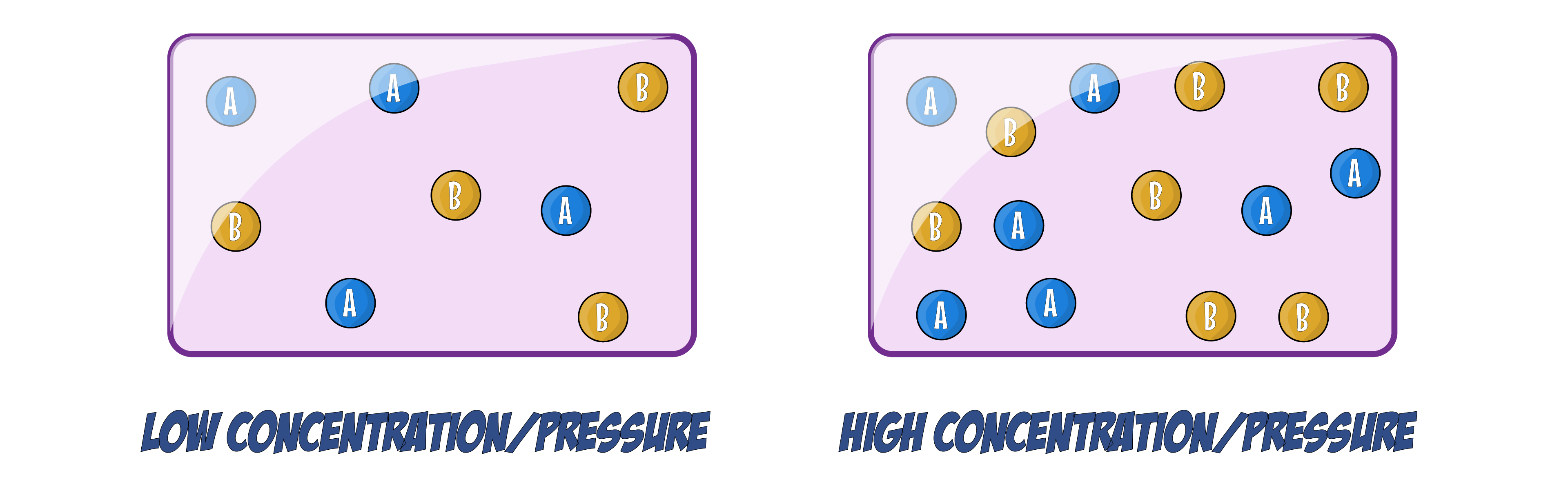
- A higher CONCENTRATION or PRESSURE results in particles being CLOSER together, meaning there are MORE FREQUENT COLLISIONS, which INCREASES the rate of reaction.
Surface Area
- You can increase the surface area to volume ratio of a reactant by breaking it down into SMALLER PARTICLES (such as powder).
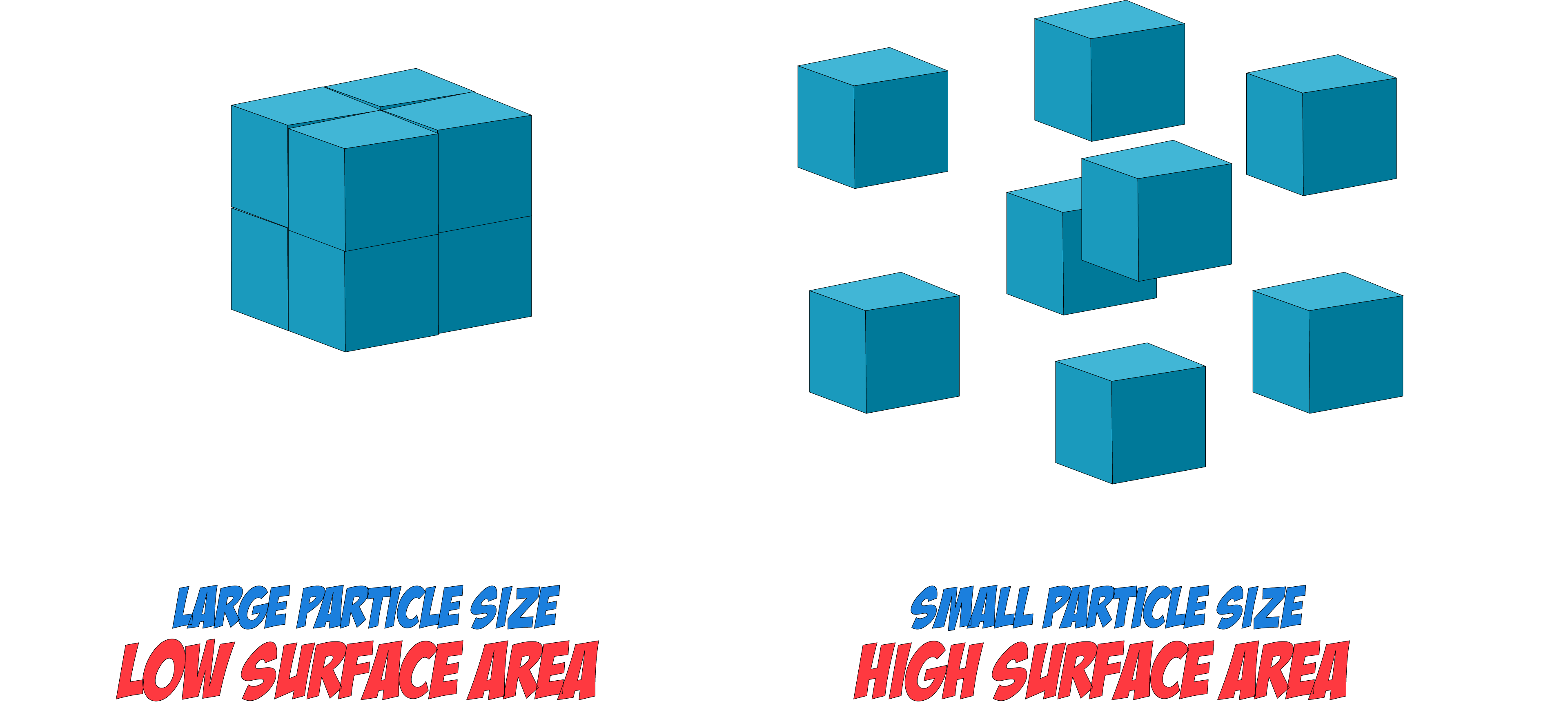
- By increasing the SURFACE AREA, we expose more reactant particles to possible collisions.
- Smaller particle sizes or finely divided materials present a larger SURFACE AREA to volume ratio, allowing for MORE FREQUENT COLLISIONS and a faster reaction rate as compared to larger chunks of the same substance.
Catalysts
- CATALYSTS are substances that INCREASE the reaction RATE without being USED UP in the reaction.
- This means they will NOT appear in the chemical equations.
- Catalysts are SPECIFIC, meaning different reactions need different catalysts.
- ENZYMES are examples of CATALYSTS that increase the rate of biological reactions.
- Catalysts work by providing an ALTERNATIVE REACTION PATHWAY with a LOWER ACTIVATION ENERGY.
- You can see activation energies on REACTION PROFILES:
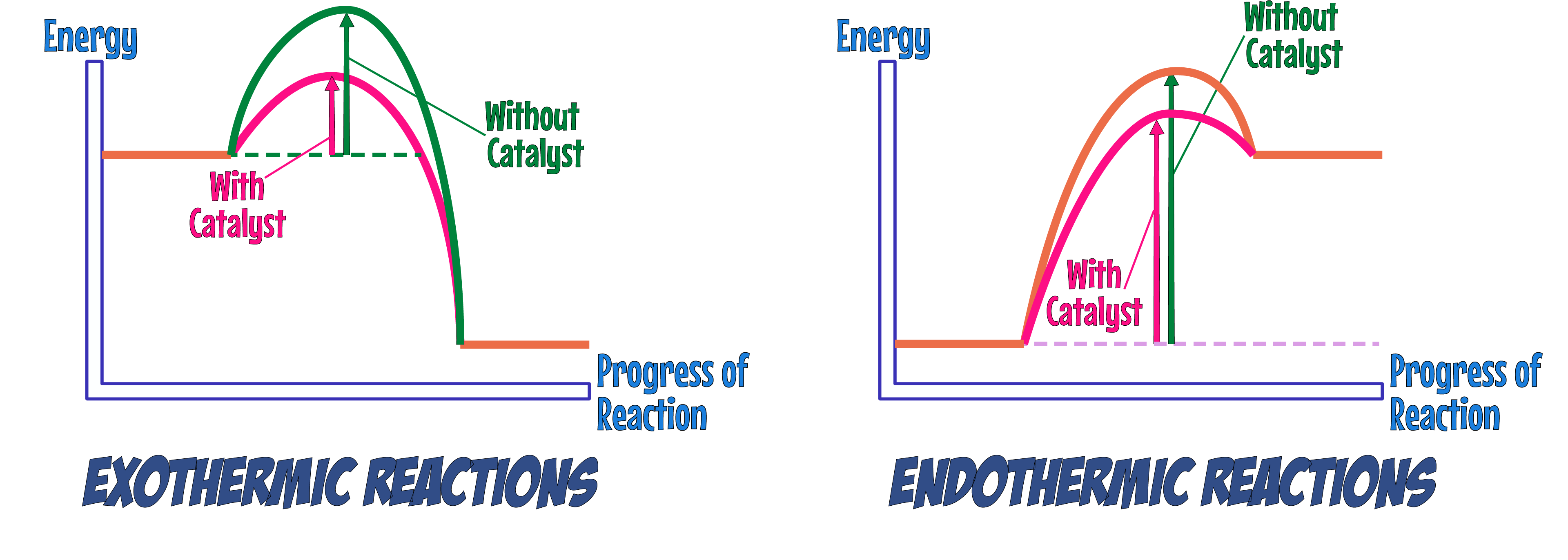
The ACTIVATION ENERGY is represented by the height from the REACTANTS to the PEAK of the graph.
You can see that the activation energy for the reactions WITH a catalyst is LOWER.
This means a greater proportion of the particles will have an energy GREATER than the ACTIVATION ENERGY, meaning there will be MORE FREQUENT COLLISIONS, which will INCREASE the rate of the reaction.