The Understanding of Genetics
Mendel’s Experiments
In the mid-19th century GREGOR MENDEL, an Austrian monk, conducted breeding experiments on PEA PLANTS.
His research laid the groundwork for modern genetics.
Mendel crossed TALL PEA PLANTS with DWARF PEA PLANTS and observed how traits were passed on to the offspring, leading to significant discoveries in inheritance.
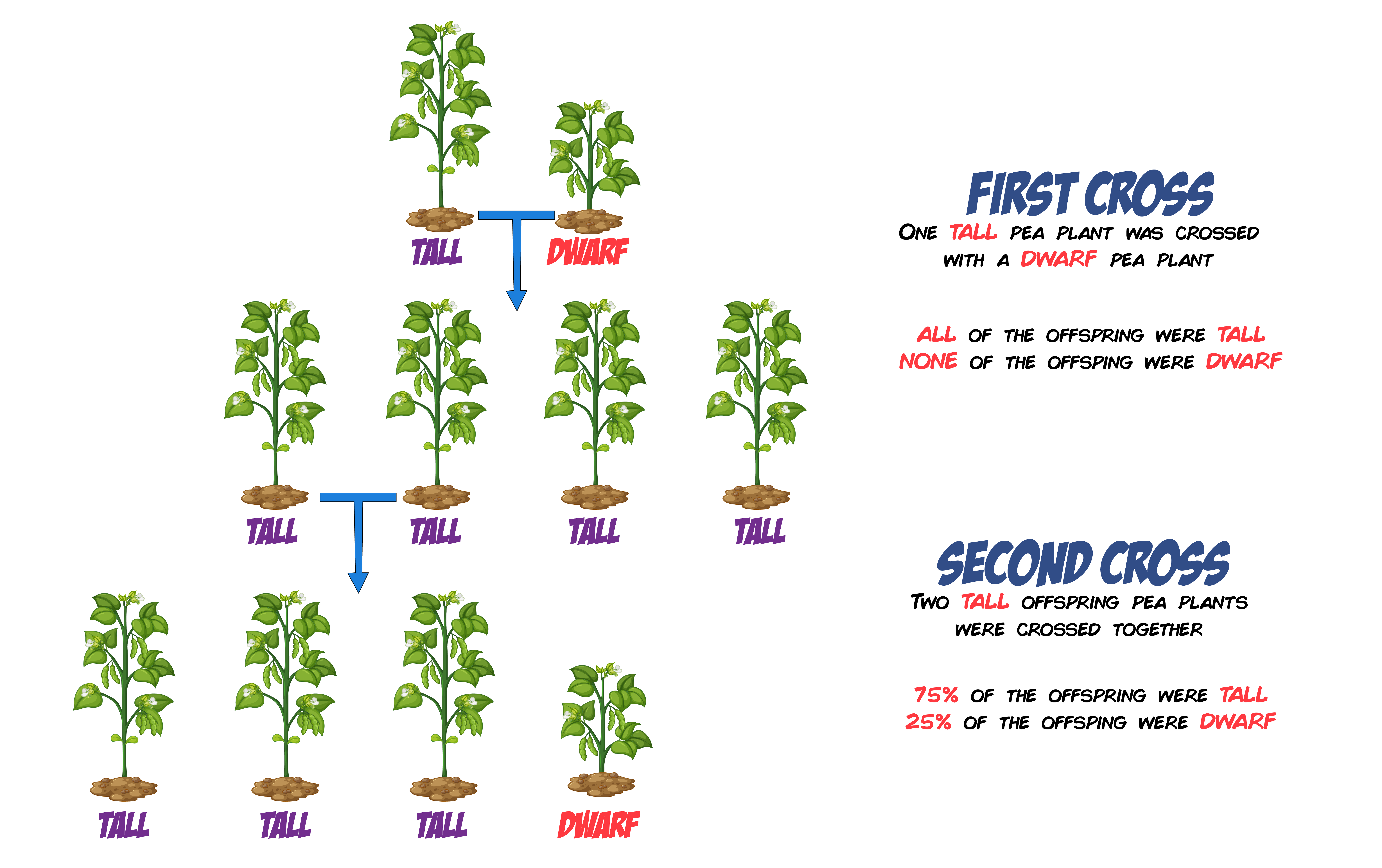
First Cross:
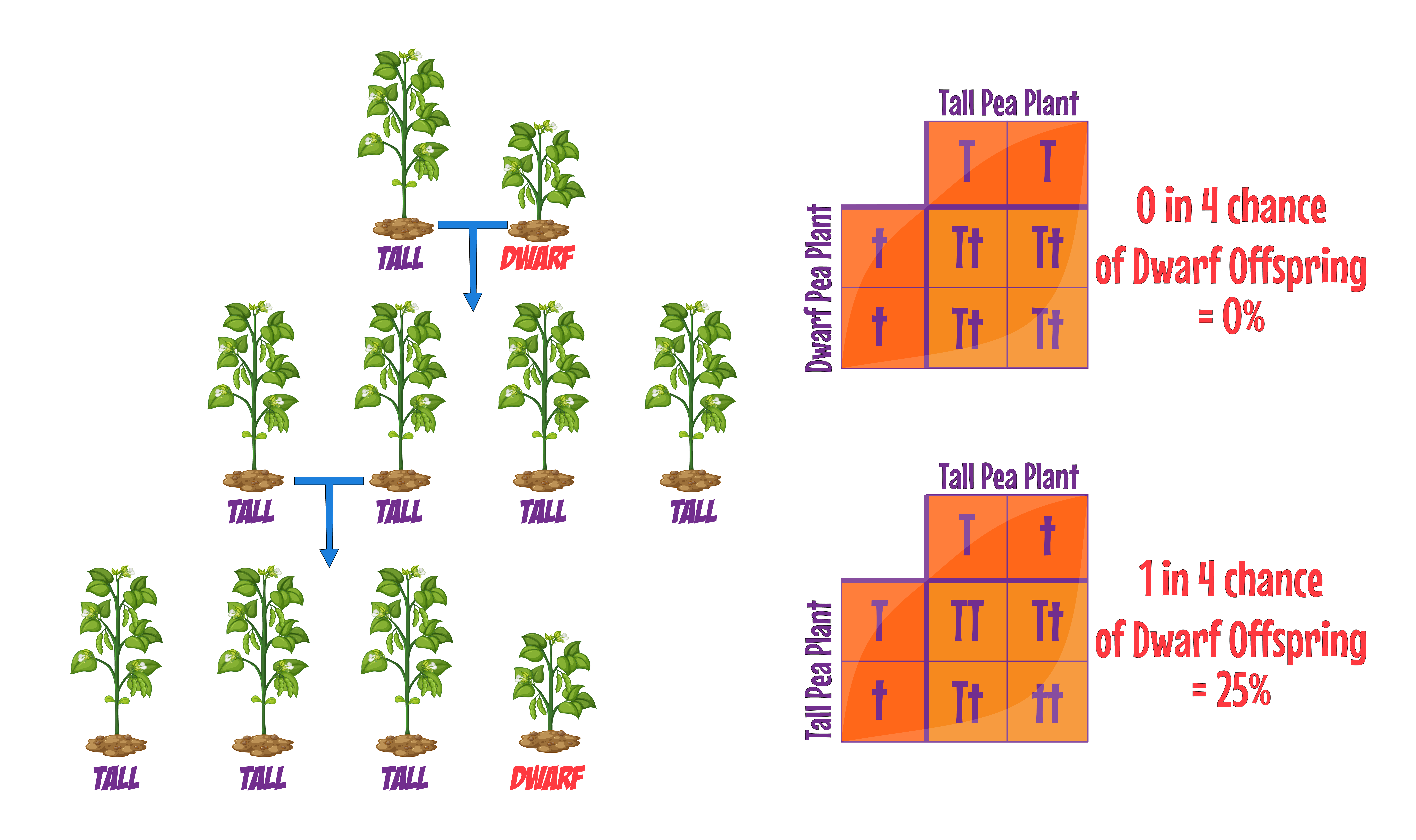
A TALL PEA PLANT was crossed with a DWARF PEA PLANT which resulted in offspring that were ALL TALL.
This showed that the trait for tall plants is DOMINANT.
Second Cross:
When TALL PLANTS from the first set of OFFSPRING were crossed among themselves, the offspring included 75% TALL pea plants and 25% DWARF pea plants.
This revealed that the dwarf trait, is RECESSIVE, as it was still present in the next generation.
Mendel’s Conclusions
When Mendel made this discovery, GENES, DNA and CHROMOSOMES had NOT been discovered, so he made the following conclusions:
1. Traits in pea plants were determined by “UNITS” (now known as GENES) that are passed from one generation to the next.
2. Mendel identified that some traits are MORE DOMINANT and mask the presence of RECESSIVE traits, which can still be passed down and appear in subsequent generations.
Understanding of Mendel’s Work
In the early 20th centrury AFTER Mendel's death, it was observed that CHROMOSOMES and Mendel's "Units" behaved in similar ways.
This led to the idea that the "units", now called GENES, were located in CHROMOSOMES.
In the mid-20th century the structure of DNA was determined and the mechanism of gene function was worked out.
This scientific work by many scientists led to the gene theory being developed.
We can now explain the pea-plant experiment using PUNNET SQUARES: