
Required Practical: Force, Mass and Acceleration
This practical involves TWO experiments :
- Investigating the effect of varying the FORCE on the ACCELERATION of an object of CONSTANT MASS.
- Investigating the effect of varying the MASS of an object on the ACCELERATION produced by a CONSTANT FORCE.
Light Gates
In both experiments, a LIGHT GATE with a DATA LOGGER is used:
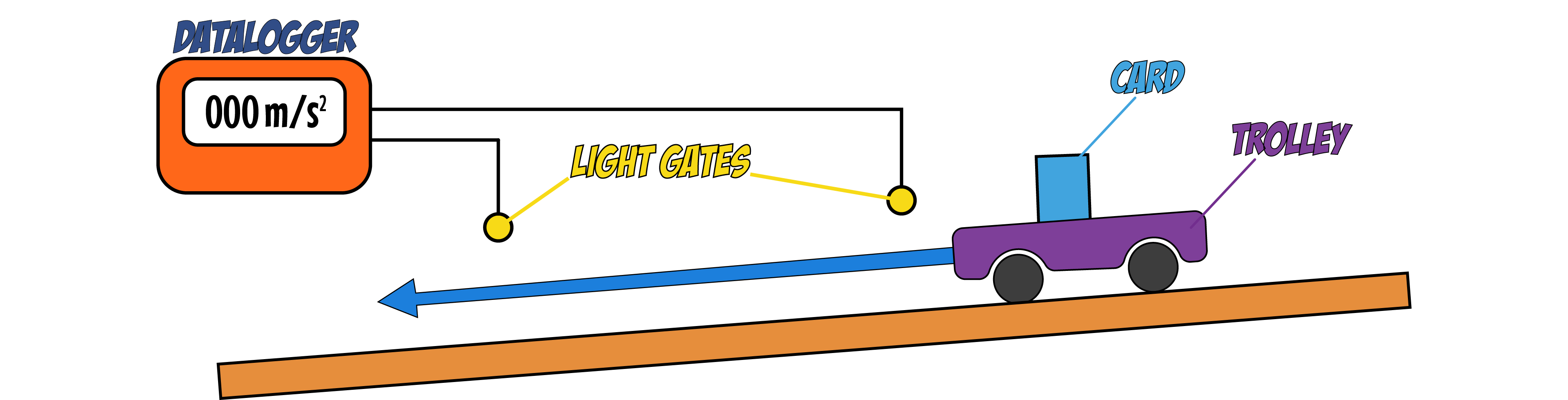
The trolley with the card interrupts the signal of the LIGHT GATE when it rolls down the ramp.
The LIGHT GATE divides the LENGTH of the CARD by the TIME the signal is interrupted for, and calculates the SPEED of the trolley.

Using a LIGHT GATE and DATA LOGGER is BETTER than using a person with a STOPWATCH, as there is:
- Less ERROR due to the human's REACTION TIME
- The CALCULATION of speed can be done AUTOMATICALLY
Effect of Force on Acceleration
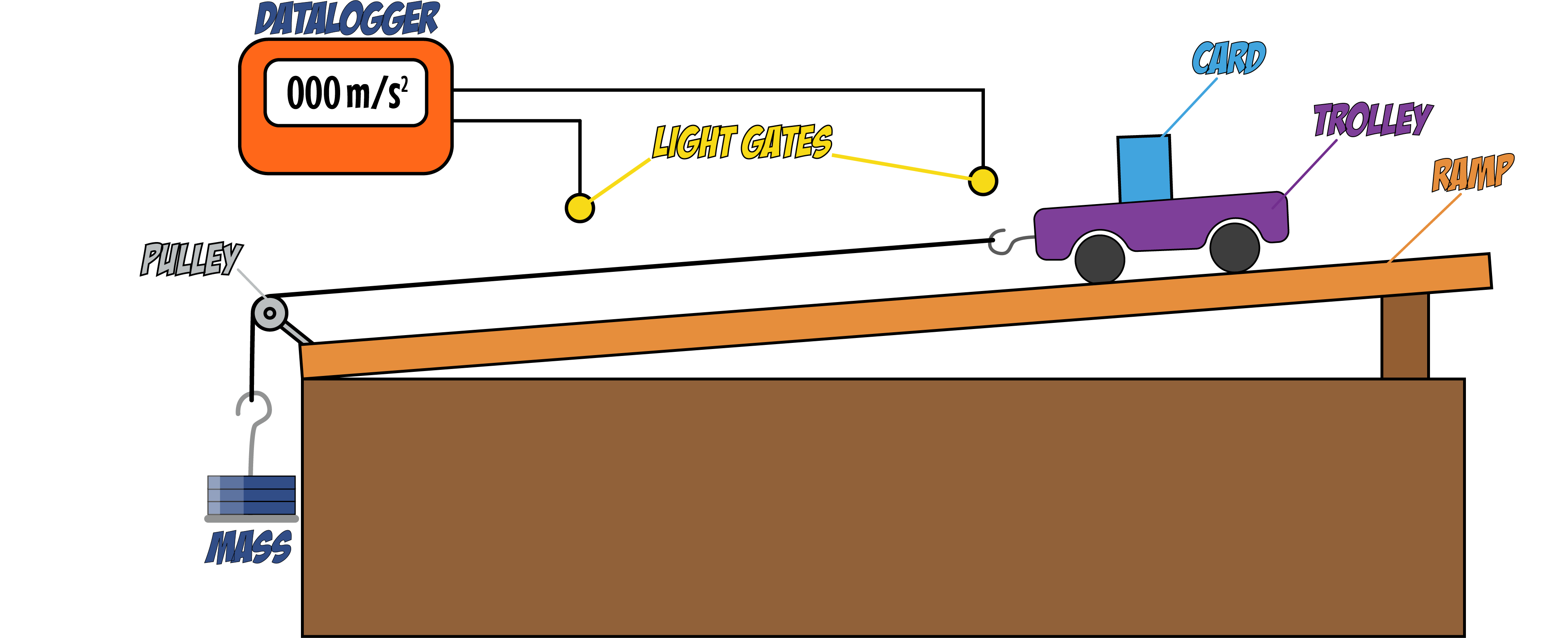
Method:
- Mark a STARTING LINE at a fixed distance from the light gate.
- Release the trolley from the top of the runway.
- As the card passes each light gate a timer turns on and off.
- The data logger calculates the velocity of the trolley at light gate A and at light gate B.
- The data logger calculates the acceleration using the two velocities and the equation:

- Repeat steps 1 to 5 using different masses HANGING off the table.
- Plot a graph of ACCELERATION against FORCE and draw a LINE OF BEST FIT.
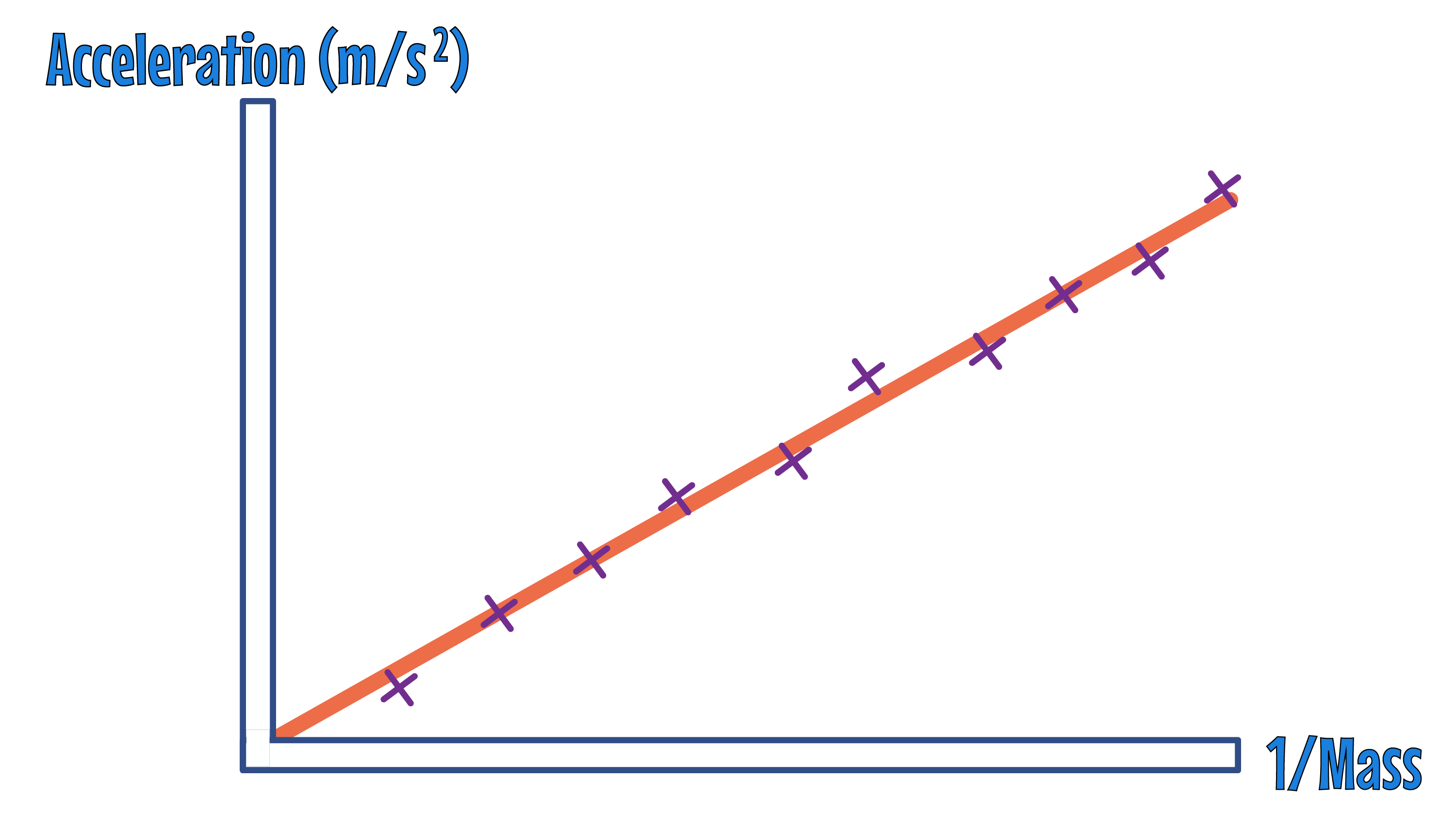
A straight line through the origin shows the FORCE and ACCELERATION are DIRECTLY PROPORTIONAL.
Effect of Mass on Acceleration
For this experiment, all the steps are the SAME however, instead of changing the mass HANGING from the table, you change the mass of the TROLLEY.
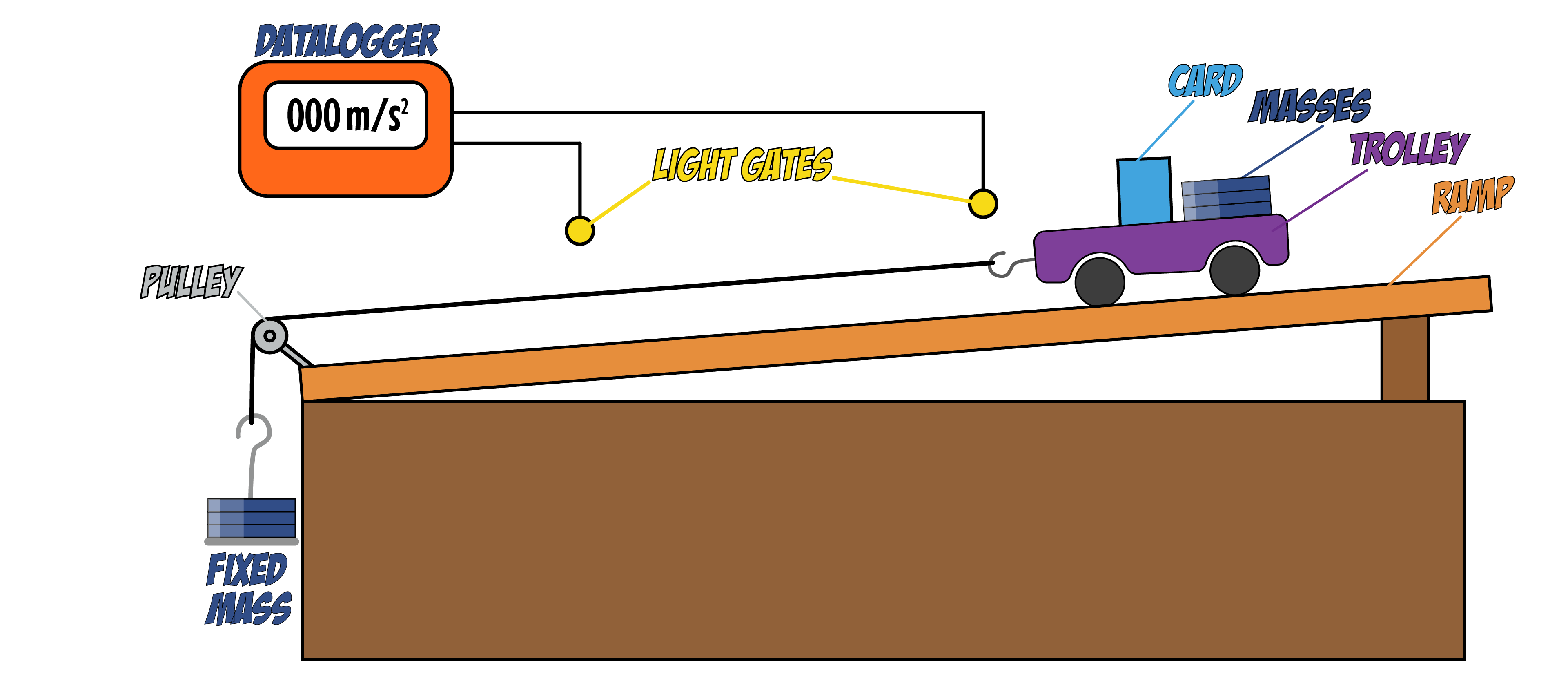
Method:
- Mark a STARTING LINE at a fixed distance from the light gate.
- Release the trolley from the top of the runway.
- As the card passes each light gate a timer turns on and off.
- The data logger calculates the velocity of the trolley at light gate A and at light gate B.
- The data logger calculates the acceleration using the two velocities.
- Repeat steps 1 to 5 using different masses added on the TROLLEY
- Plot a graph of ACCELERATION against 1/MASS and draw a LINE OF BEST FIT.
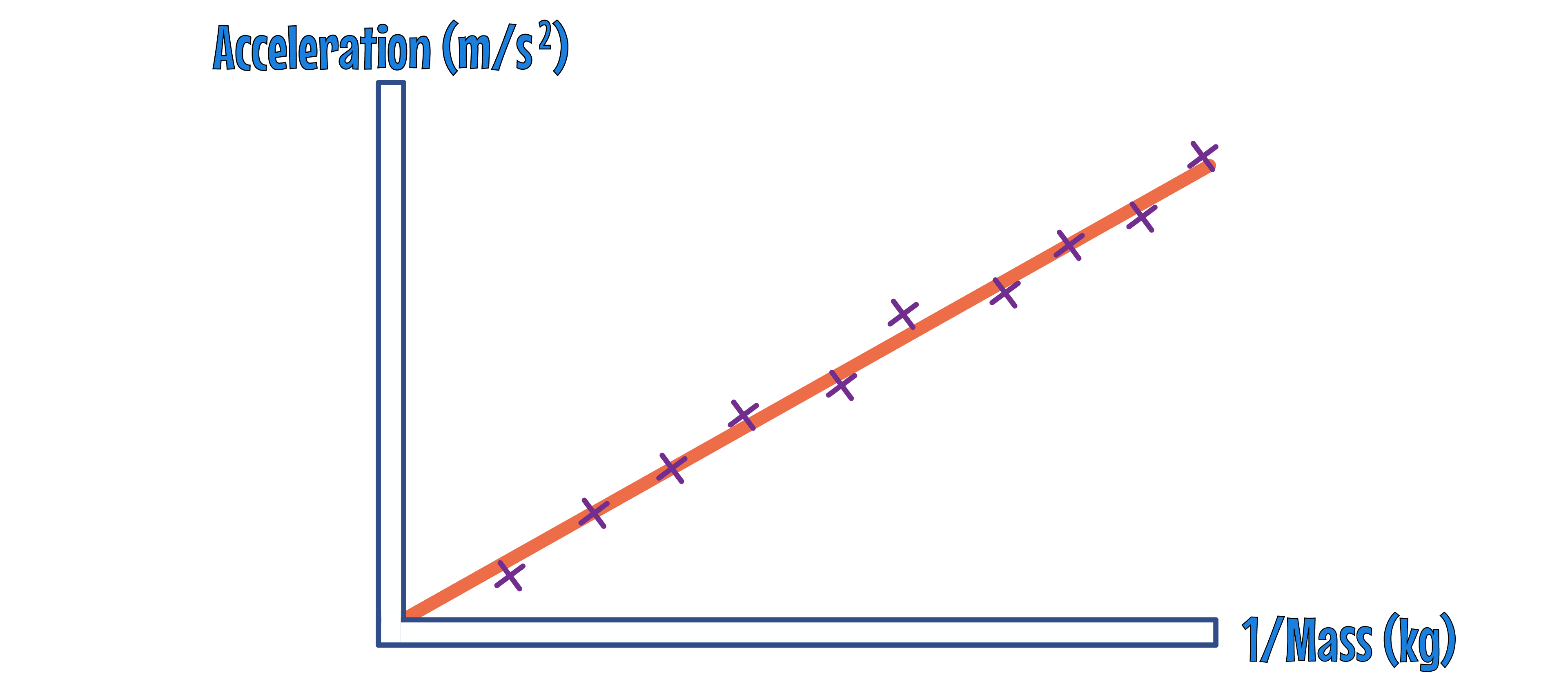
This shows that acceleration and 1/mass are directly proportional, which means ACCELERATION and MASS are INVERSELY PROPORTIONAL.
Reducing Friction
Friction between the wheels of the trolley and the ramp can cause inaccuracies in the experiment.
These frictional forces can be reduced by:
- SLOPING the ramp.
- Using a GLIDER and AIR TRACK (a track which hovers a trolley on jets of air).