Visible Light
The VISIBLE LIGHT SPECTRUM includes all the COLOURS that can be seen by the human eye.
Visble light can be REFLECTED, ABSORBED, or TRANSMITTED based on what type they are:
- OPAQUE objects do NOT transmit light.
- TRANSPARENT objects TRANSMIT LIGHT with little to no obstruction, so they do not alter the colour of the light.
- TRANSLUCENT objects TRANSMIT LIGHT but scatter it in the process, which can slightly alter the perception of colour.
Types of Reflection
Opaque objects can be seen when light REFLECTS off them and enters our eyes. Some objects appear more SHINY than others because of the TYPE of reflection that occurs.
There are TWO types of reflection:
1. Specular Reflection:
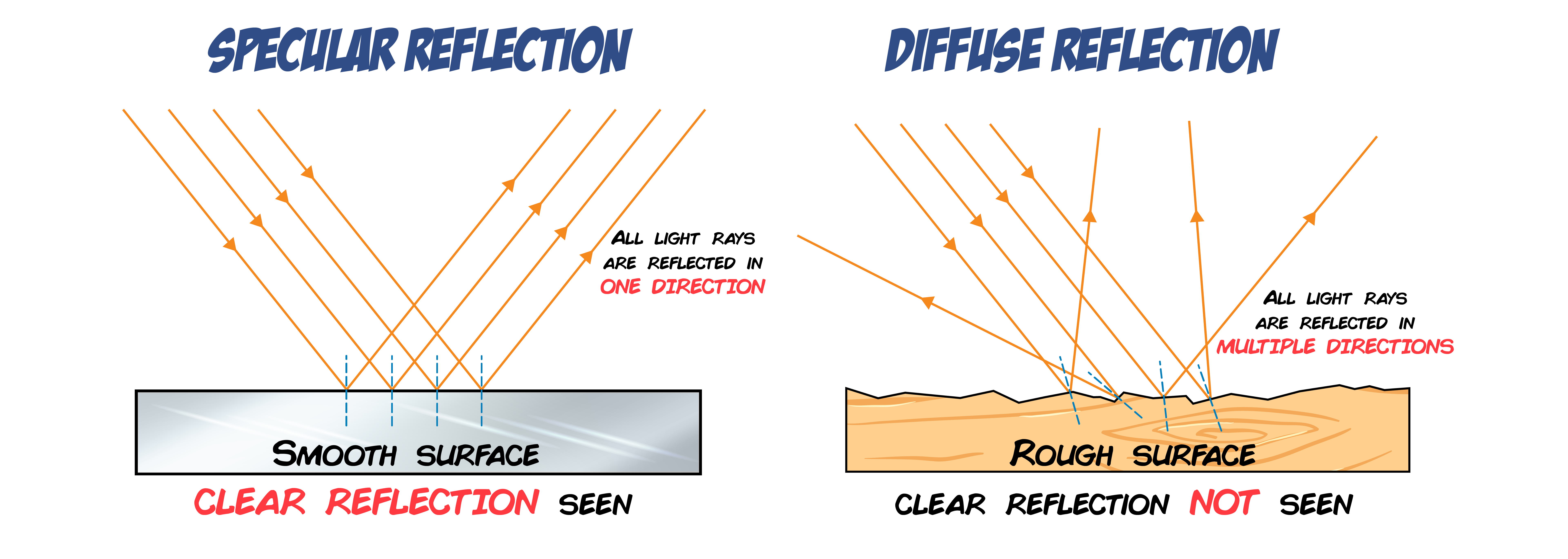
SPECULAR REFLECTION occurs when light rays reflect off a SMOOTH surface such as a mirror.
In specular reflection, all reflected rays are PARALLEL if the incident rays are also parallel, producing a CLEAR IMAGE.
Light reflection always follows the LAW OF REFLECTION, where the angle of incidence (the angle at which the light hits the surface) equals the angle of reflection (the angle at which light reflects off the surface).
In SPECULAR REFLECTION all the rays hit the surface at the SAME angle of INCIDENCE so they all have the SAME angle of REFLECTION too.
2. Diffuse Reflection
DIFFUSE REFLECTION occurs when light rays reflect off a ROUGH or irregular surface, such as paper or unpolished wood.
Unlike specular reflection, diffuse reflection SCATTERS light in MULTIPLE directions. This scattering results in NO clear image in the reflection.
In DIFFUSE REFLECTION all the rays hit the surface at DIFFERENT angles of INCIDENCE so they all reflect at DIFFERENT ANGLES to each other.
The scattered light reaches our eyes from different angles, allowing the object’s surface to be visible from multiple perspectives, but with NO clear reflection.
Colour Perception and Light Absorption
Each colour corresponds to a specific WAVELENGTH and FREQUENCY.
The colour of an object is determined by which wavelengths of light it absorbs and which it reflects. For example:

An object appears RED if it absorbs other wavelengths but reflects red light.
An object appears WHITE if it reflects all wavelengths of light and doesn't absorb any.
An object appears BLACK if it absorbs all wavelengths of light without reflecting any.
colour Filters
colour FILTERS are devices that allow only light of specific colours (wavelengths) to pass through them while absorbing other colours.
This selective transmission of light explains why objects appear in different colours when viewed through various filters.
How Filters Work

When white light (which contains all colours of the spectrum) passes through a colour filter, only the colour corresponding to the filter is transmitted. The other colours are absorbed.
A RED FILTER, for example, allows red light to pass through while absorbing green and blue light. Similarly, a BLUE FILTER transmits blue light and absorbs red and green light, and a GREEN FILTER permits green light while absorbing red and blue light.
The colour an object appears when viewed through a filter depends on the colour of light the object reflects:
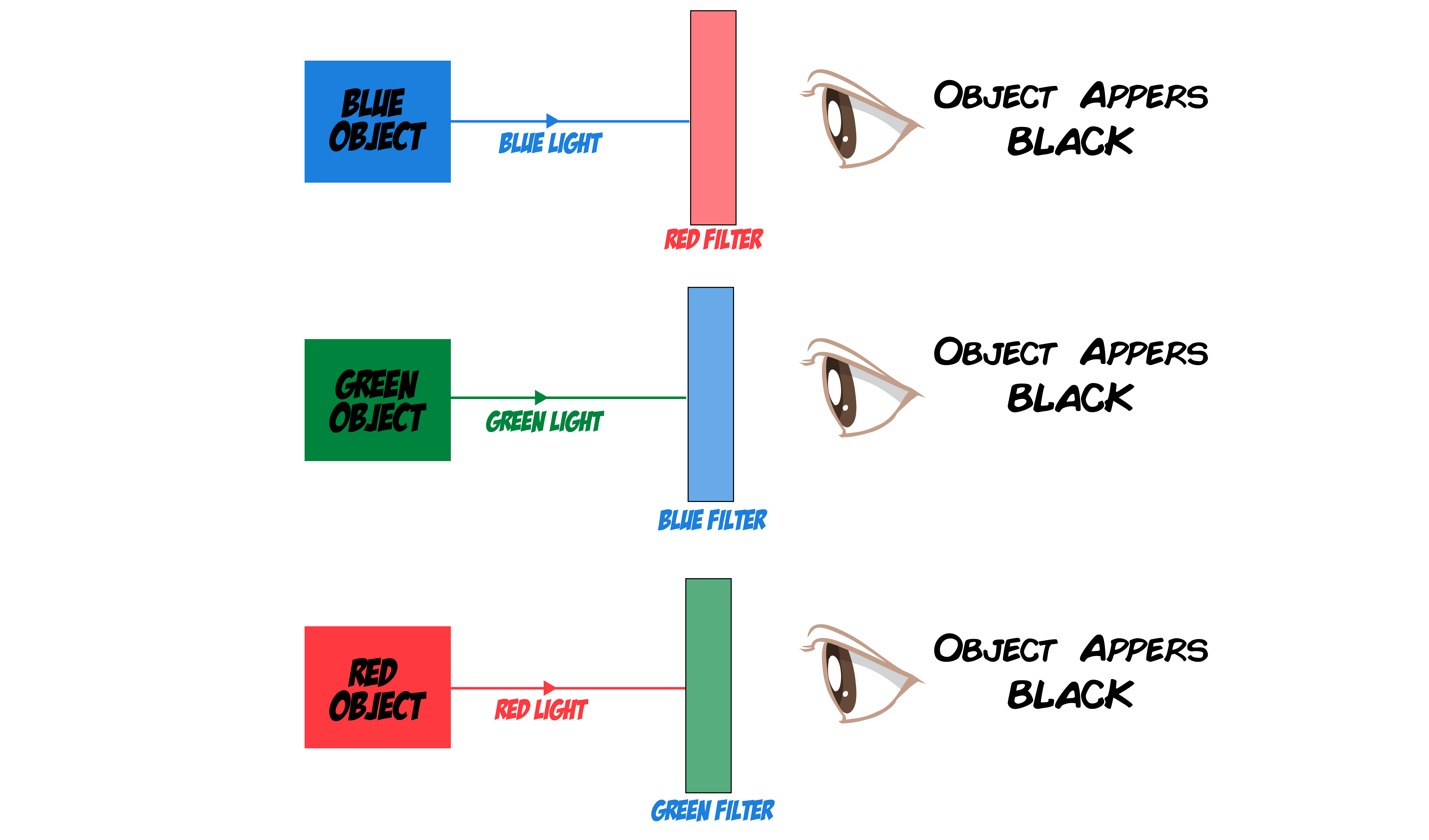
A RED OBJECT will appear black when viewed through a BLUE or GREEN FILTER because there is no red light to transmit through these filters.
A BLUE OBJECT will appear black when viewed through a red or green filter for the same reason; these filters do not transmit the blue light that the object reflects.
Similarly, a GREEN OBJECT appears black through a red or blue filter because the light it reflects (green) is not transmitted by these filters.