Nuclear Fission and Fusion
Nuclear FISSION and FUSION are both ways of releasing ENERGY from the NUCLEI of ATOMS.
Nuclear Fission
NUCLEAR FISSION is the process where a large and unstable nucleus, such as URANIUM or PLUTONIUM, SPLITS into two smaller nuclei.
This splitting releases a significant amount of ENERGY.
The Process of Fission
Fission typically requires a NUCLEUS to absorb a NEUTRON (Spontaneous fission without a neutron is very rare).
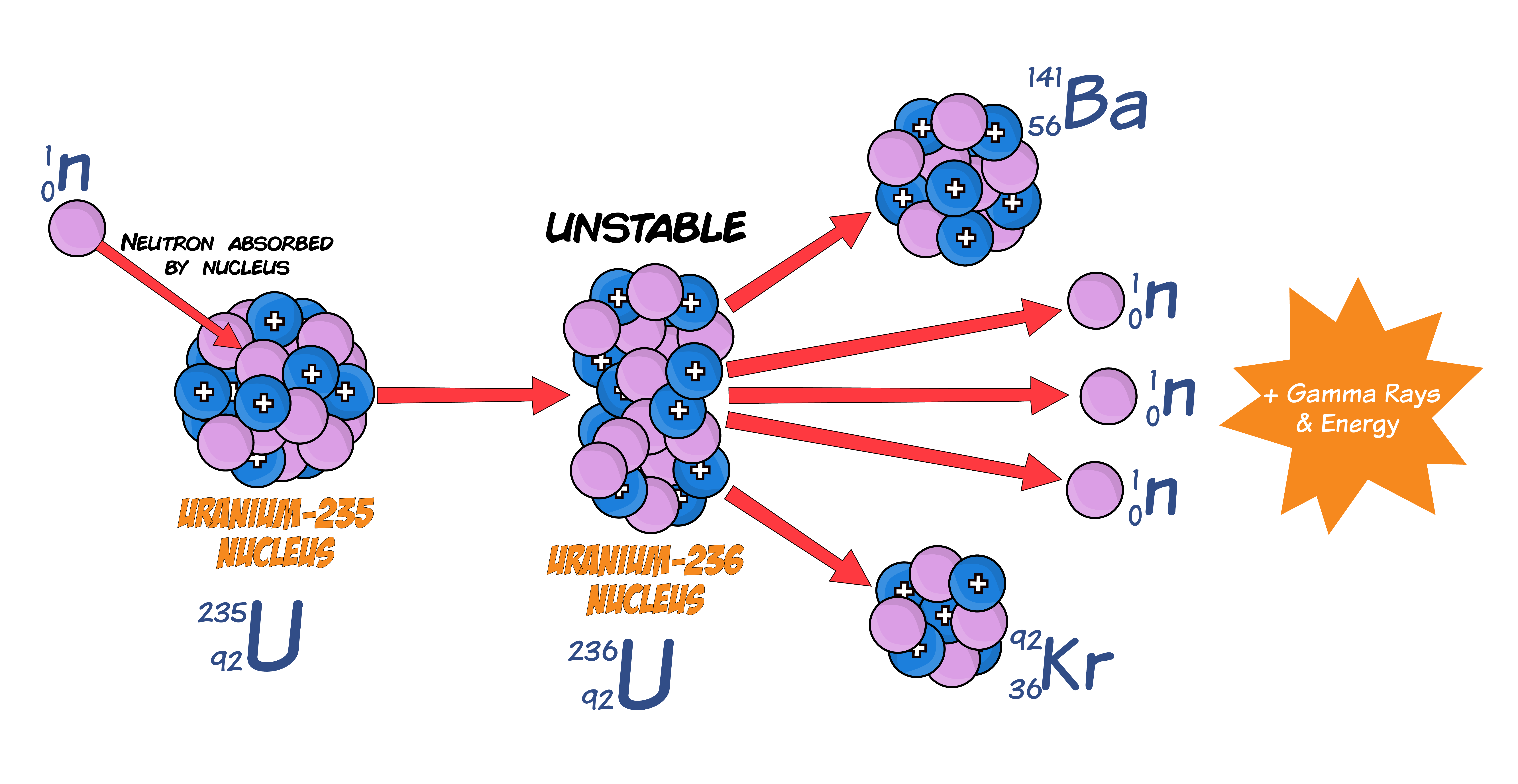
The additional neutron makes the NUCLEUS become UNSTABLE, which causes it to SPLIT into two SMALLER nuclei, which are roughly equal in size.
Along with these nuclei, two or three NEUTRONS and GAMMA RAYS are emitted.
The energy released in this reaction is mainly due to the KINETIC ENERGY of the fission products and the neutrons.

The neutrons produced may strike OTHER unstable nuclei, causing FURTHER fission reactions. This is known as a CHAIN REACTION.
In a NUCLEAR REACTOR, this chain reaction is carefully CONTROLLED to steadily release energy used for GENERATING ELECTRICITY.
If UNCONTROLLED, the chain reaction can lead to a massive and rapid release of energy, causing an explosion; This is how NUCLEAR WEAPONS work.