Current, Resistance, and Potential Difference
POTENTIAL DIFFERENCE (V)
Also known as VOLTAGE, potential difference is the measure of ENERGY per unit of CHARGE, transferred between two points in a circuit.
Simply put, this is the driving force that PUSHES the current around the circuit.
Units: VOLTS (V).
RESISTANCE (R)
RESISTANCE in a circuit SLOWS down the flow of CURRENT.
The HIGHER the resistance in a circuit, the LOWER the current, if the potential difference stays the same.
Units: OHMS (Ω).
OHM'S LAW
The relationship between current, resistance, and potential difference can be understood by OHM'S LAW, which states that the CURRENT is DIRECTLY PROPORTIONAL to the POTENTIAL DIFFERENCE.
A conductor that obeys this law is known as an OHMIC CONDUCTOR.
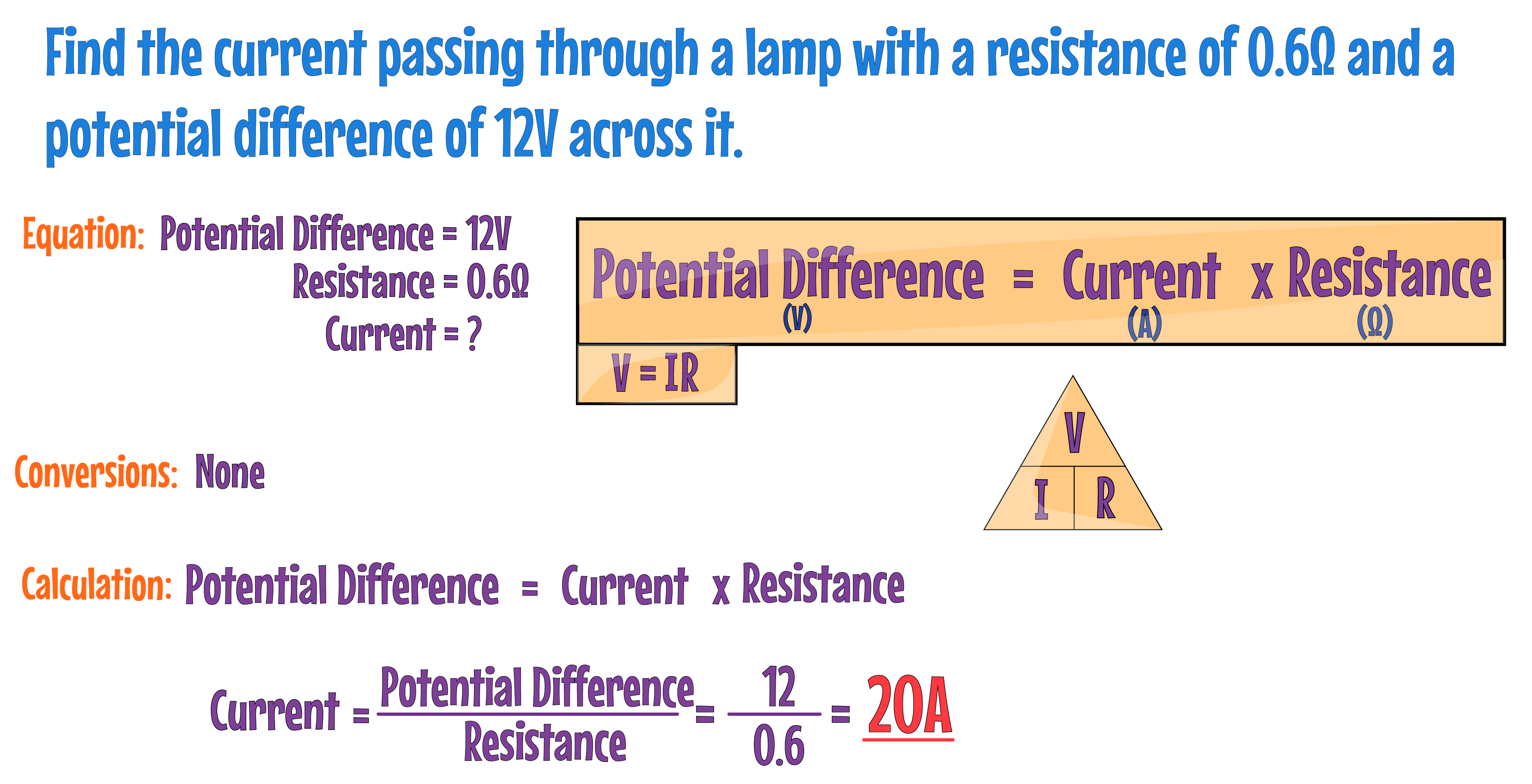
Here's the fundamental formula you'll need:

- V is the potential difference in Volts (V).
- I is the current in Amperes (A).
- R is the resistance in Ohms (Ω).