Required Practical: Titration
TITRATION is an experimental technique used for NEUTRALISATION REACTIONS.
They allow you to find out exactly how much ACID is needed to neutralise an ALKALI and vice versa.
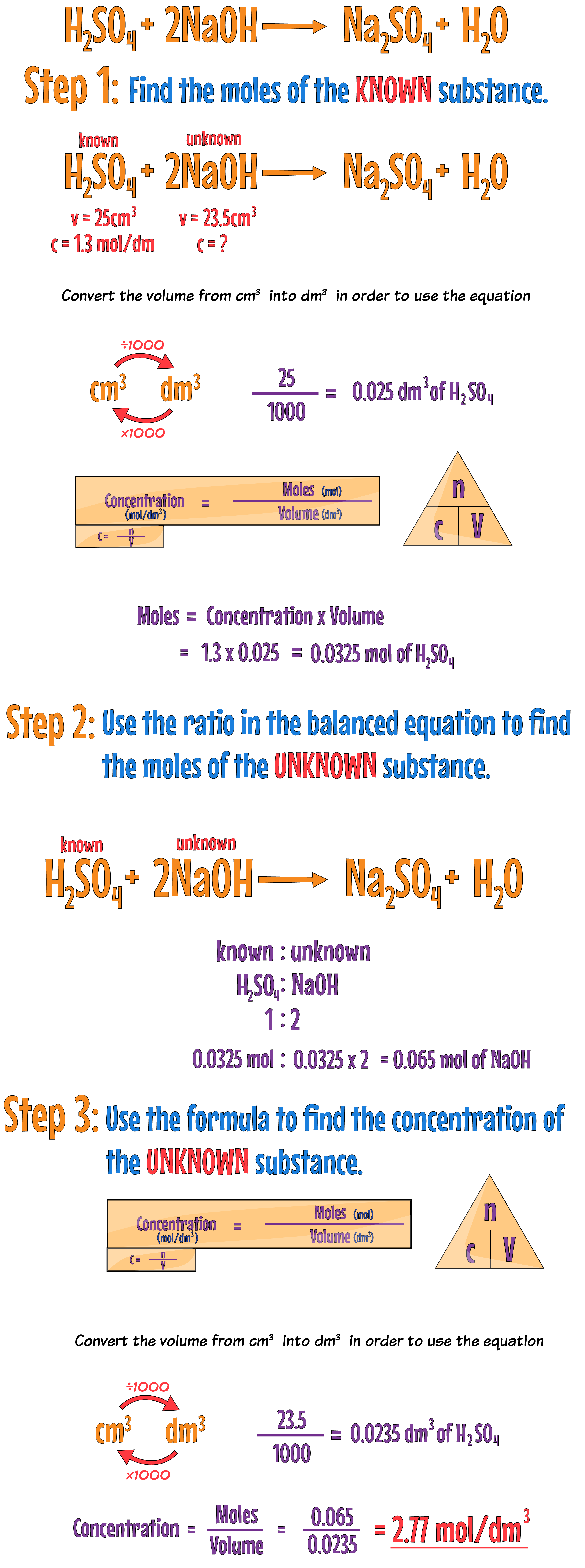
This means, you can use a KNOWN concentration to find an UNKNOWN concentration.
Set Up
Here is the apparatus needed for a TITRATION:
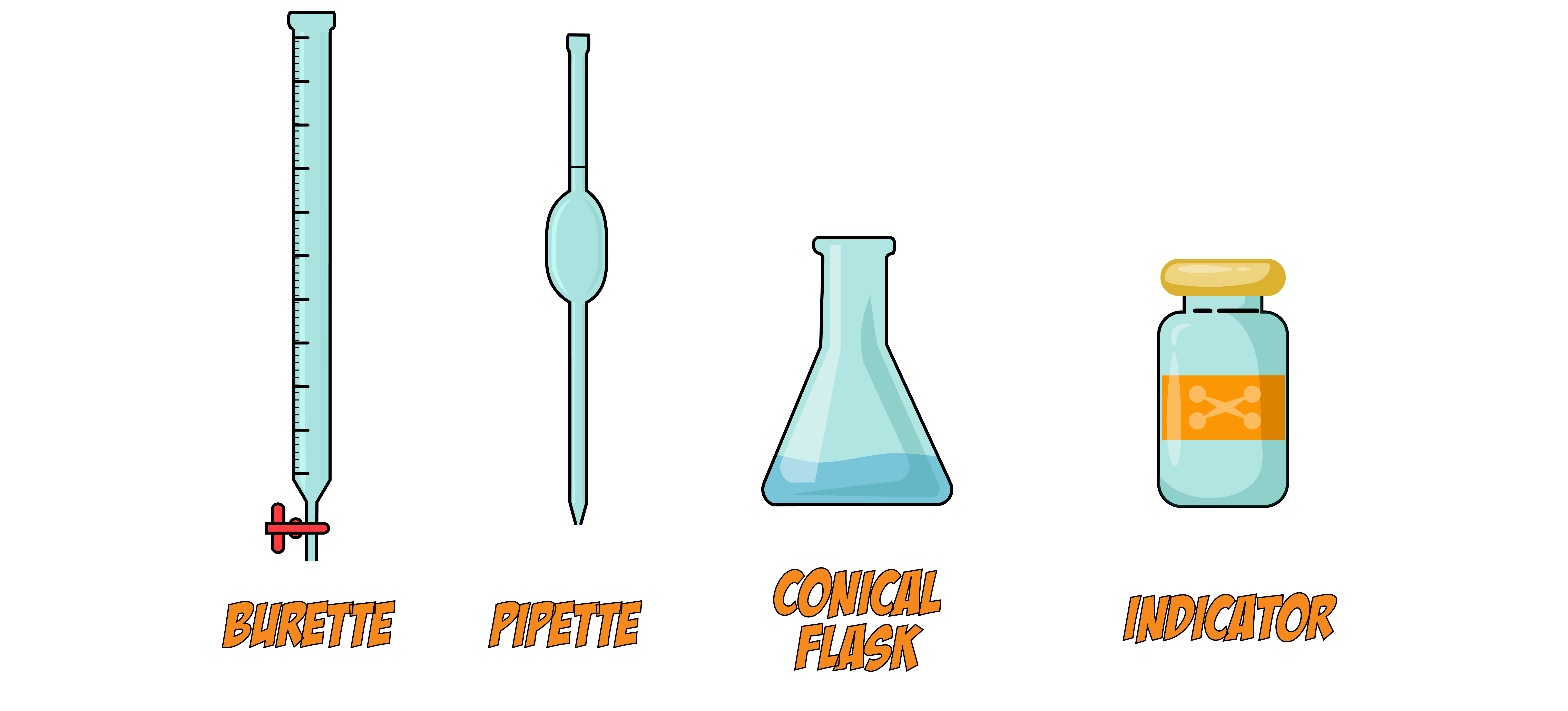
A BURETTE has a TAP that allows a solution to be added to a flask. It is used to MEASURE VARIABLE VOLUMES very accurately, so you can easily see how much solution has been added.
A PIPETTE is used to measure a fixed volume (25cm3) more accurately than a measuring cylinder.
NARROW-RANGE indicators are used for titrations as they show a INSTANT change in colour when neutralisation occurs. Examples include PHENOLPHTHALEIN, METHYL ORANGE and LITMUS.

Method
As an example, lets use a solution of SULFURIC ACID with a concentration of 1.3mol/dm3 being neutralised with SODIUM HYDROXIDE with an UNKNOWN concentration. We can use a TITRATION to find out the concentration of the sodium hydroxide.
Here are the steps to follow:
1. Use the PIPETTE to measure 25cm3 of sulfuric acid into the conical flask.
2. Fill the BURETTE with sodium hydroxide using a funnel.
3. Record the initial reading of acid in the burette. - Make sure to always take readings from the bottom of the MENISCUS.
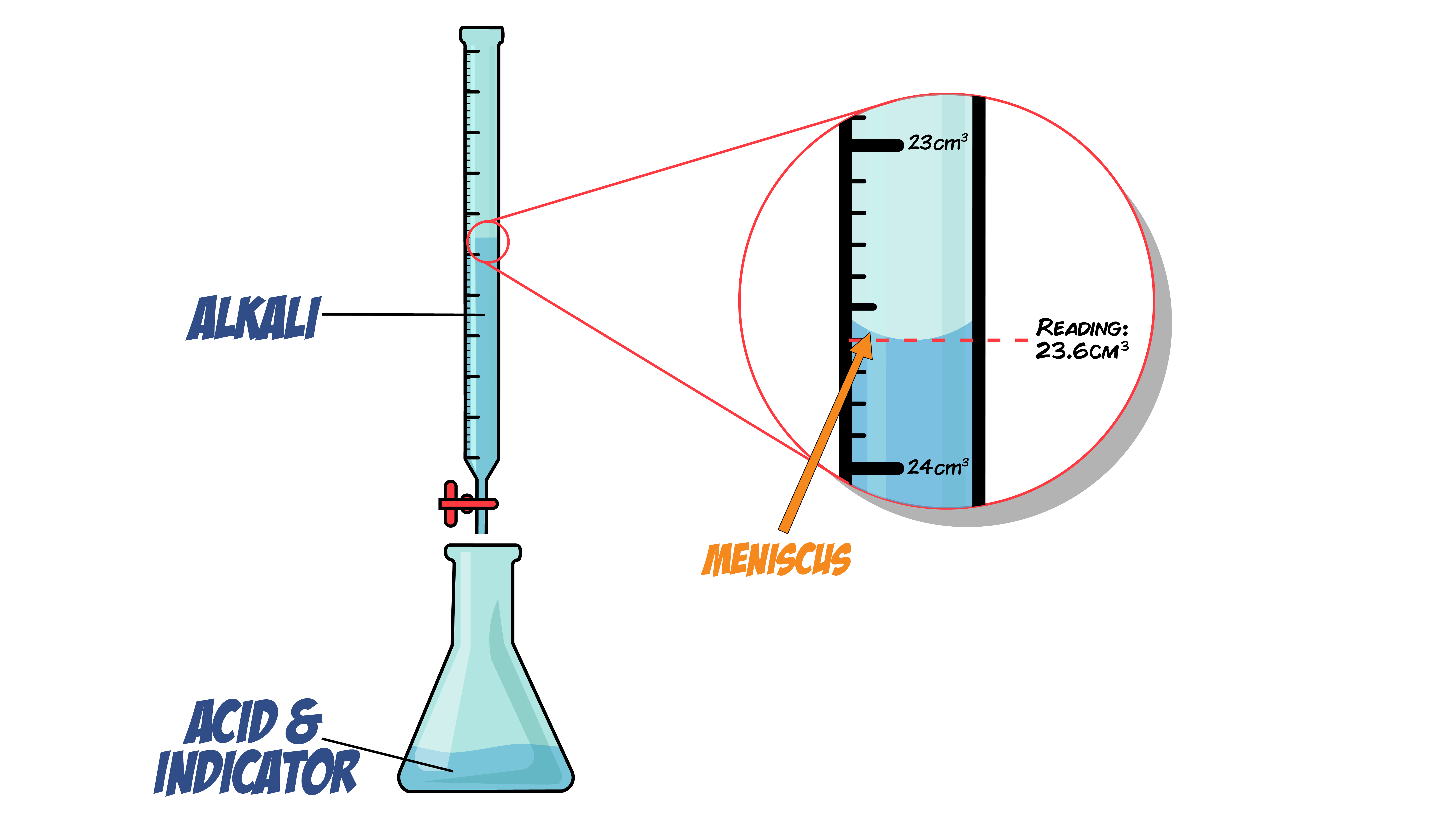
5. Add a few drops of INDICATOR to the conical flask.
6. OPEN the burette tap and SWIRL the conical flask.
7. Add acid DROP-BY-DROP near the endpoint.
8. When a colour change occurs, CLOSE the burette tap.
9. Record the final reading of acid in the burette and calculate the titre (final volume - initial volume).
10. Repeat until you have CONCORDANT results. - These are within 0.1cm3 of each other.
Finding the Concentration of an Unknown Solution
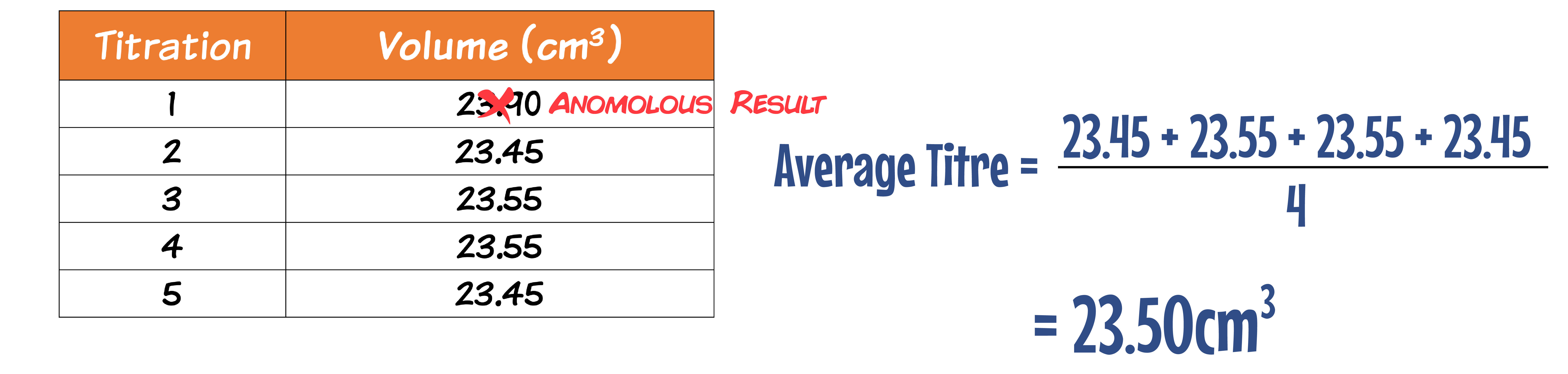
All of results from the titration can be recorded on a TABLE

To find the concentration of the sodium hydroxide, you need to ignore ANOMALOUS results and find the AVERAGE TITRE.
Now we can follow the steps of MOLE CALCULATIONS to find the CONCENTRATION of the unknown sodium hydroxide.