
Cracking
CRACKING
CRACKING is a process where LONG HYDROCARBONS are broken down into SMALLER, more USEFUL molecules.
There's a HIGH DEMAND for fuels with small molecules, making the products of cracking very important as FUELS.
There are TWO types of cracking:
1. CATALYTIC CRACKING:
This involves heating the hydrocarbon to vaporise it.
The VAPOUR is then passed over a HOT POWDERED ALUMINIUM OXIDE CATALYST.
This causes the long chained molecules to break down on the surface of the catalyst.
2. STEAM CRACKING:
This involves vaporising the long hydrocarbons and MIXING them with STEAM.
The mixture is then HEATED to very high temperatures to break down the molecules.
Here is an example of a cracking reaction:
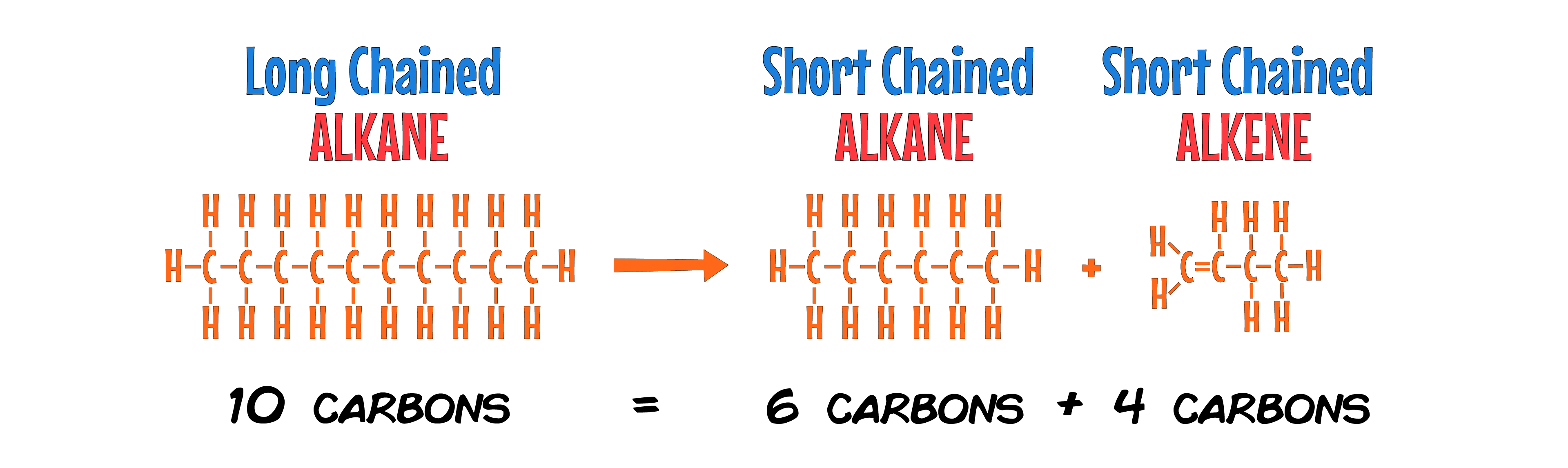
The PRODUCTS OF CRACKING include:
- ALKANES: Saturated hydrocarbons with single bonds between carbon atoms.
- ALKENES: Unsaturated hydrocarbons with at least one double bond between carbon atoms.