
Simple Molecular Substances (Small Molecules)
Simple molecular substances consist of SMALL MOLECULES formed by COVALENT BONDS.
These are NOT large networks but SMALL GROUPS of atoms bonded together.
Familiar examples include, Hydrogen (H₂), Oxygen (O₂), Water (H₂O) and Chlorine (Cl₂).
Properties of Simple Molecular Substances
There are TWO bonds involved in simple molecular substances:
1. COVALENT BONDS
These are the bonds BETWEEN ATOMS which are STRONG and need A LOT of energy to overcome.
2. INTERMOLECULAR FORCES:
These are the forces BETWEEN MOLECULES which are WEAK and do NOT need a lot of energy to overcome.

Melting and Boiling Points:
When simple molecular substances MELT or BOIL, it is the INTERMOLECULAR FORCES that need to be broken, NOT the covalent bonds.
These intermolecular forces are WEAK, meaning only a SMALL amount of energy is needed to overcome them.
This gives simple molecular substances LOW MELTING and BOILING points.
This is why they are usually found as LIQUIDS or GASES at room temperature.
Strength of Intermolecular Forces:
Intermolecular forces are always WEAK when compared to COVALENT bonds, but some intermolecular forces are weaker than others.
The LARGER the molecule, the STRONGER the intermolecular forces. This is because the molecule has MORE ELECTRONS.
Let’s compare the boiling points of Chlorine and Iodine:
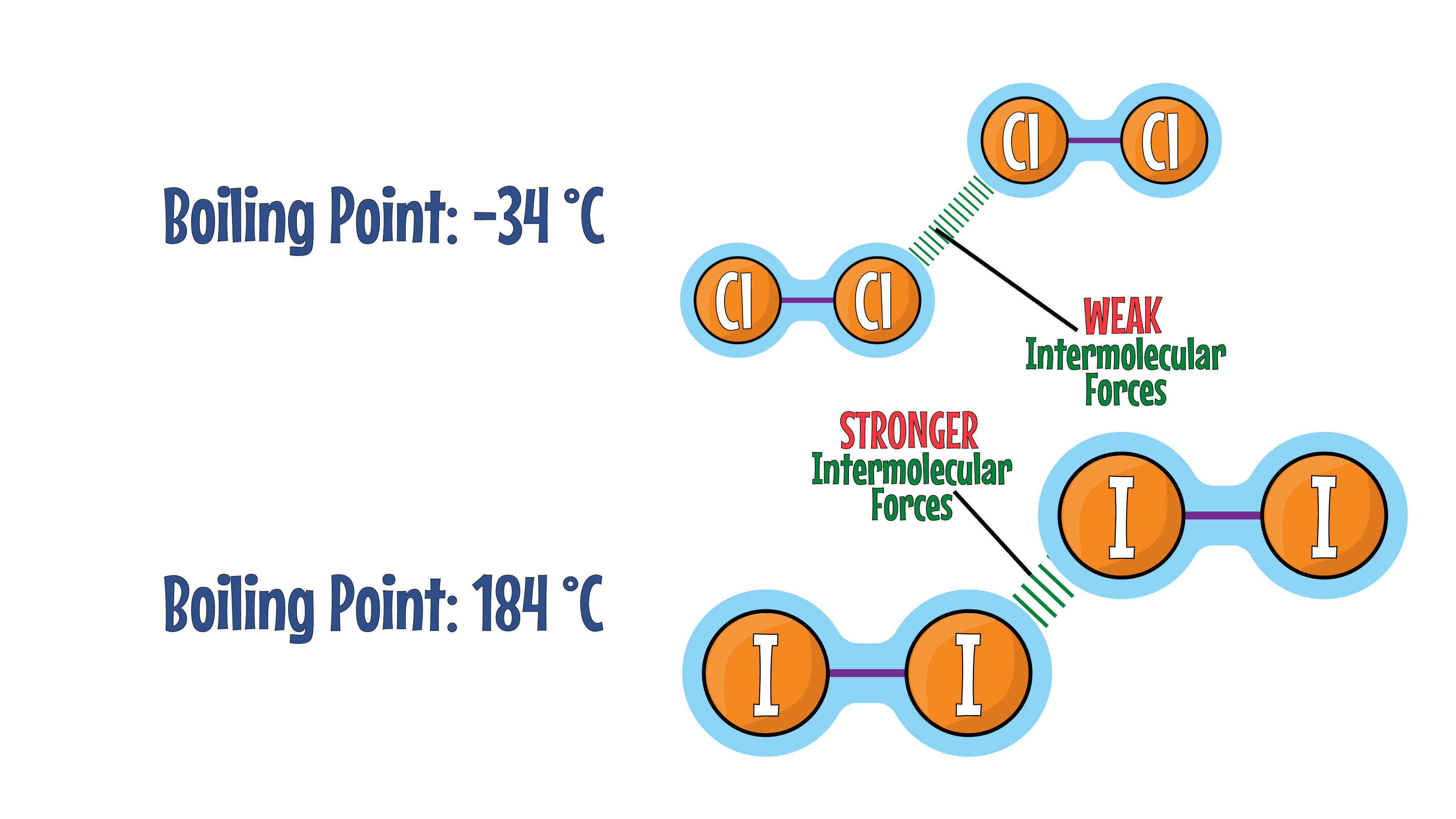
Iodine atoms are LARGER as they are further down the periodic table.
This means Iodine molecules have MORE ELECTRONS, meaning there are STRONGER INTERMOLECULAR forces between the molecules.
MORE ENERGY is required to OVERCOME these forces which means Iodine has a HIGHER melting and boiling point than Chlorine.
Electrical Conductivity:
For a substance to conduct electricity, it needs to contain CHARGED PARTICLES that are free to move (usually electrons or ions).
Simple molecular substances do NOT have an overall electric charge, therefore these substances generally do not conduct electricity because they do not contain FREE MOVING ELECTRONS OR IONS.