
Ionic Bonding
UNDERSTANDING IONS
-
IONS are atoms or groups of atoms that have LOST OR GAINED ELECTRONS and have a CHARGE.
-
Metals LOSE ELECTRONS to form POSITIVE IONS or CATIONS.
- Non-metals GAIN ELECTRONS to form NEGATIVE IONS or ANIONS.
How Ions Form
Ions form when electrons are TRANSFERRED between atoms to achieve a FULL OUTER SHELL. This makes them MORE STABLE.
Let’s look at a SODIUM atom as an example:

There is ONE electron in its outer shell, so the easiest way it can achieve a FULL OUTER SHELL is by LOSING 1 electron.

Once it has lost the electron, it becomes an ION.
To show this, you draw its structure within SQUARE BRACKETS and show its CHARGE on the top right.
It becomes POSITIVE because it has LOST a NEGATIVELY charged electron.
Now let’s look at an OXYGEN atom as an example:

This time, the atom has SIX outer electrons, so it needs to GAIN TWO electrons to achieve a FULL OUTER SHELL.

This time the extra electrons have made the atom turn into a NEGATIVE ion.
It has a charge of -2 as TWO electrons were added.
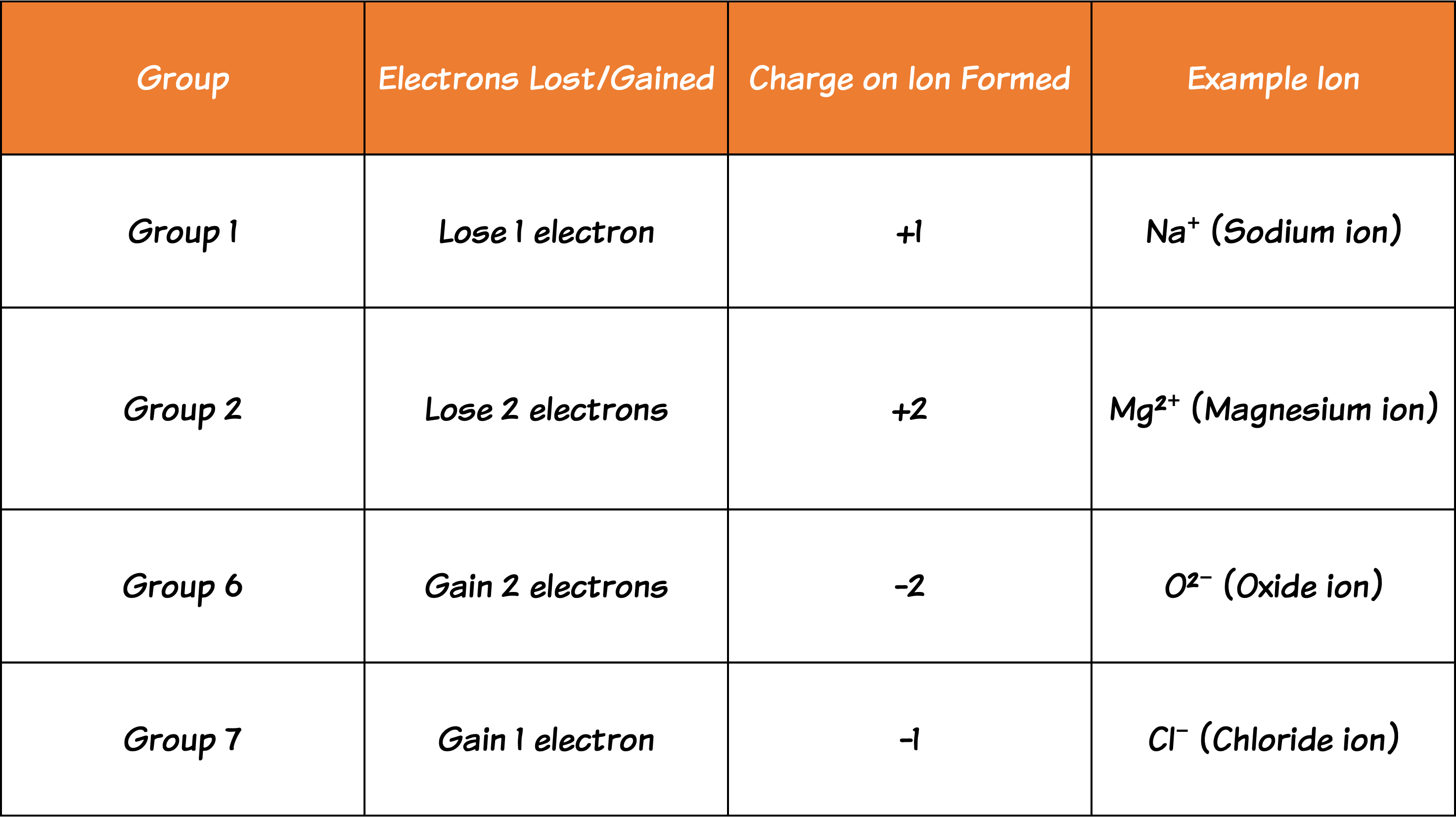
You can predict what type of ion an atom will form by knowing the GROUP of the element:
IONIC BONDING
- This type of bonding occurs between a METAL and a NON-METAL.
- IONIC BONDING involves the TRANSFER of electrons FROM a METAL atom TO a NON-METAL atom.
- The METAL atom LOSES electrons to become a POSITIVELY charged ion, while the NON-METAL atom GAINS those electrons to become a NEGATIVELY charged ion.
- These ions are then STRONGLY attracted to each other by ELECTROSTATIC forces, creating an IONIC BOND.
DOT AND CROSS DIAGRAMS
DOT AND CROSS DIAGRAMS represent the ARRANGEMENT of electrons in atoms or ions where each electron is symbolised by a dot or a cross. These diagrams show which atom the electrons originally came from.
EXAMPLE 1 - Let’s look at LITHIUM FLUORIDE:
Lithium has ONE outer shell electron, and Fluorine has SEVEN.

The best way for BOTH atoms to get a full outer shell is for LITHIUM to TRANSFER ONE electron to FLUORINE.

This gives BOTH atoms a FULL OUTER SHELL and STABILITY.

As Lithium LOSES ONE electron is gets a +1 charge and Fluorine GAINS ONE electron it gets a -1 charge.

Both ions are OPPOSITELY CHARGED and they have ELECTROSTATIC FORCES of ATTRACTION holding them together. This is known as the IONIC BOND.
The Li+ and F- join to give the final formula for Lithium Fluoride as LiF.
EXAMPLE 2 - Let's look at a more difficult example for LITHIUM OXIDE:
Lithium has ONE outer shell electron, but Oxygen has SIX.

This time Lithium needs to LOSE ONE electron, but Oxygen needs to GAIN TWO. This means you would need ANOTHER Lithium atom to provide a SECOND electron to Oxygen.
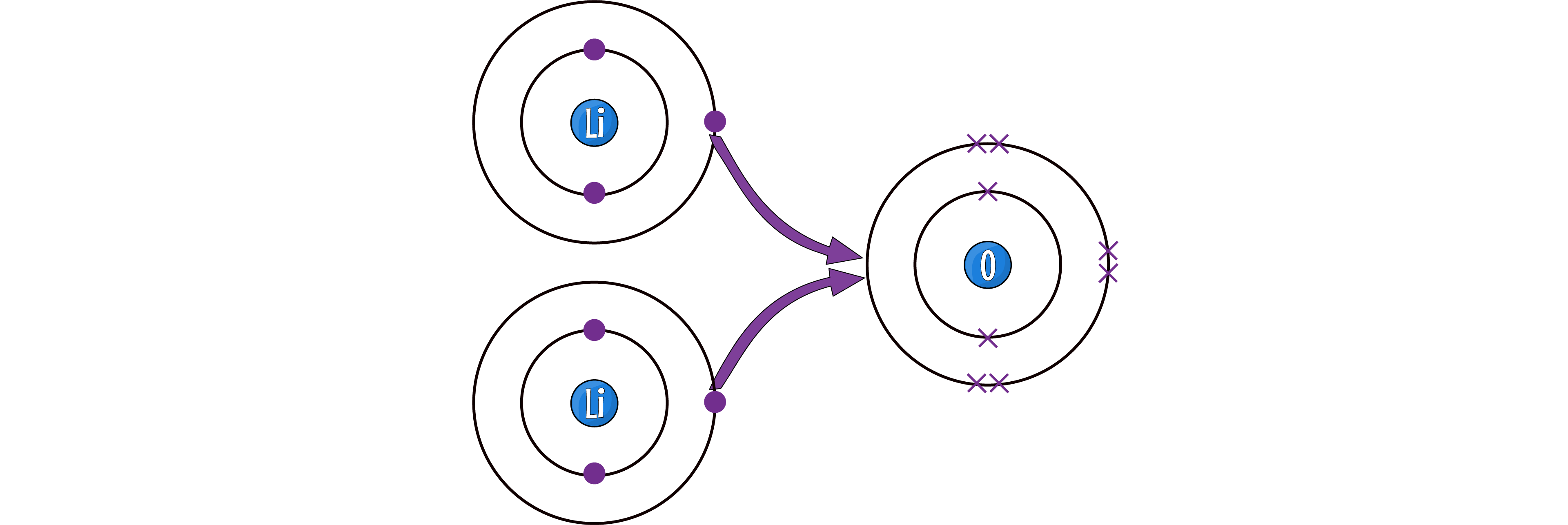
Now they are STABLE with FULL OUTER SHELLS.
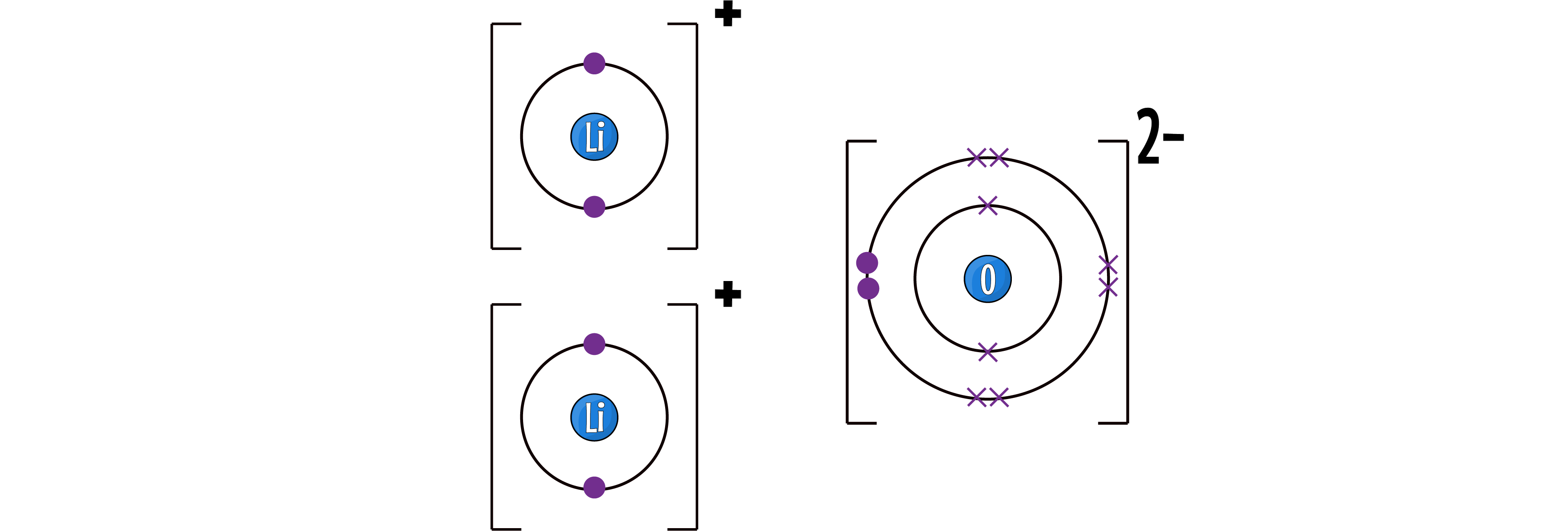
The Li+ and O2- join to give the final formula for Lithium Oxide as Li₂O.