
The Periodic Table
Early Periodic Tables
- In the early 1800s, elements were primarily organised by ATOMIC WEIGHT and their PHYSICAL AND CHEMICAL PROPERTIES.
- ATOMIC WEIGHT was the only measurable data early scientists could use, as the concept of protons, neutrons and electrons was not yet discovered.
- This led to the creation of early periodic tables, where PROPERTIES kept repeating PERIODICALLY, hence the term PERIODIC TABLE.
- But these early periodic tables were INCOMPLETE and some elements were placed in INAPPROPRIATE GROUPS if the strict order of ATOMIC WEIGHTS was followed.
Mendeleev's Periodic Table
In 1969, DMITRI MENDELEEV, improved upon earlier tables by arranging 50 known elements by ATOMIC WEIGHT but also considered their PROPERTIES to maintain consistency within groups.
He did NOT force elements into groups that didn’t fit the patterns. Instead he made TWO CHANGES:
1. He left GAPS for elements that he thought would fit the groups but had NOT been DISCOVERED yet.
E.g. Mendeleev PREDICTED the existence and PROPERTIES of EKA-ALUMINIUM (now known as GALLIUM)
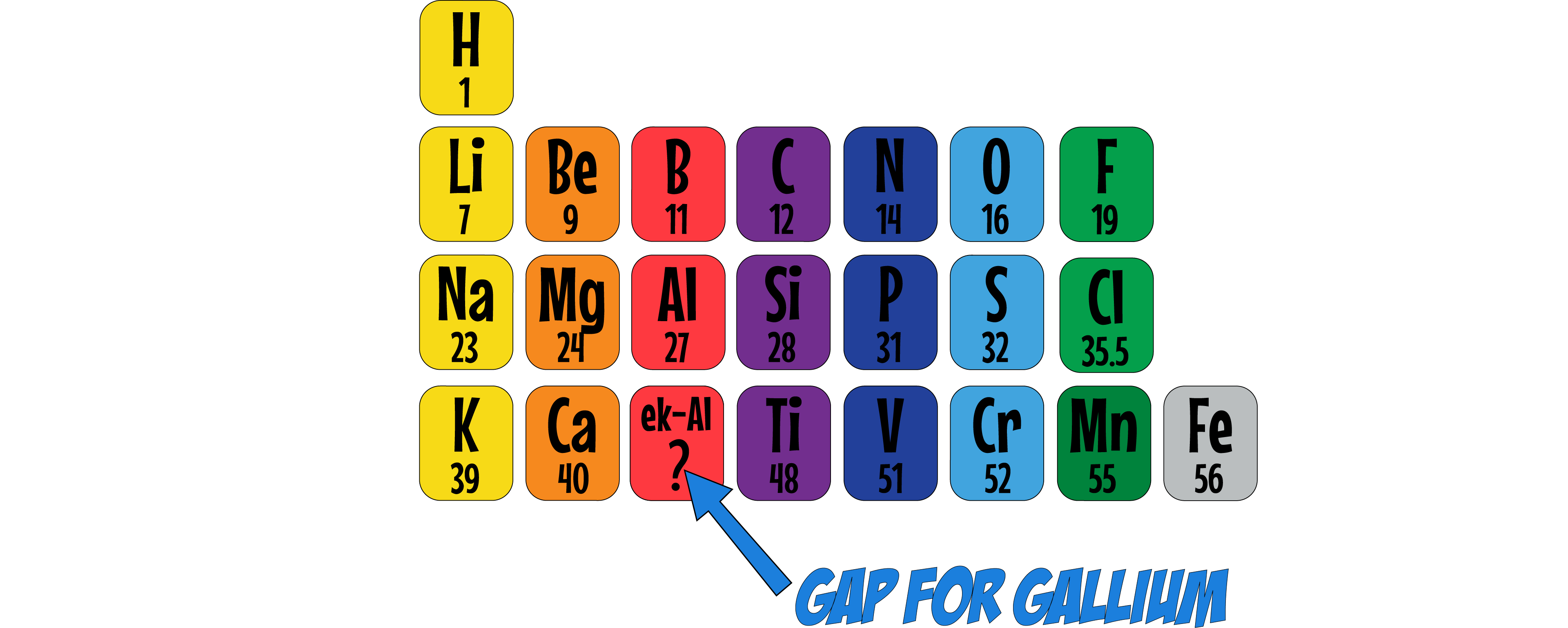
2. He CHANGED the ORDERS of some elements, even though their atomic weights did not fit this order.
E.g. Tellurium (Te) and Iodine (I). Usually, elements are lined up by their weight, and Iodine should be before Tellurium because it's lighter. But Mendeleev switched them. He put Tellurium before Iodine because its properties were more similar to the other elements in its column.
These TWO CHANGES turned out to be the right thing to do because:
1. The elements he left gaps for were discovered later and FITTED the pattern he had PREDICTED, which solidified his theories.
2. The discovery of ISOTOPES in the early 20th century confirmed Mendeleev's decision not to place elements in a strict order of atomic weight but to account for their chemical properties. This is because isotopes have different masses BUT they have the SAME CHEMICAL PROPERTIES so they occupy the SAME POSITION on the periodic table.
Eventually Mendeleev’s periodic table developed into the modern table we use today.
The Modern Periodic Table
The PERIODIC TABLE arranges about 100 ELEMENTS, based on increasing ATOMIC (PROTON) NUMBER.
It reveals repeating patterns in the properties of the elements, which is why properties recur PERIODICALLY.