
Required Practical: Enzymes
Practical Investigation of Amylase Activity
- This experiment is carried out to see the effect of pH on enzyme activity.
- The enzyme used is AMYLASE which breaks down STARCH into MALTOSE.
- The reaction will involve the amylase reacting with starch solution
- This reaction can be monitored using IODINE solution, which changes from brown-orange to blue-black in the presence of starch.

- If the enzyme does it’s job and the reaction is SUCCESSFUL, the starch will turn into maltose and the iodine solution will be BROWN-ORANGE.
- If the enzymes DENATURE and the reaction is NOT CARRIED OUT, starch will remain present and the iodine solution will be BLUE-BLACK.
- A BUFFER solution is used to change the pH of the reaction
Steps for Enzyme Activity Experiment
To examine the impact of pH on amylase, you can set up a practical experiment using the following steps:
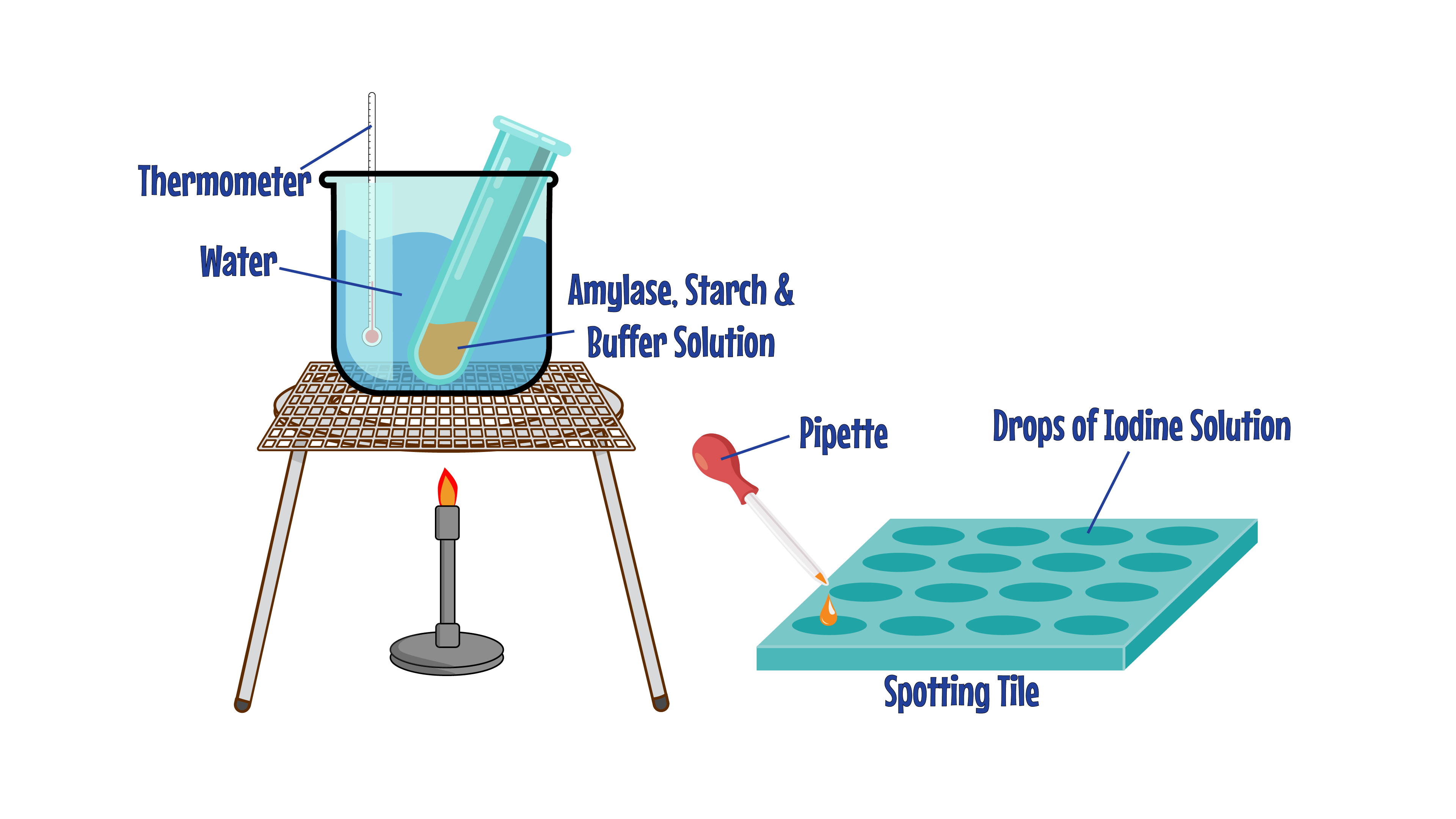
- Add iodine solution to each well of a SPOTTING TILE.
- Set up a WATER BATH at 35°C using a beaker of water and a thermometer for consistent temperature control during the experiment.
- Combine 1 cm³ of amylase solution with 1 cm³ of a buffer solution with a pH of 5 in a test tube.
- Place the tube in the water bath for five minutes using test tube holders.
- Add 5 cm³ of starch solution to the amylase and buffer mixture and start timing the reaction using a stopwatch.
- Every 30 seconds, use a DROPPING PIPETTE to add a drop of the mixture to the iodine on the spotting tile.
- Note the colour of the iodine
- Record when the iodine no longer turns BLUE-BLACK, indicating starch breakdown.
- Repeat with buffers of different pH values to see the effect of pH on amylase activity.
Understanding the Results
- The sooner the colour of the iodine solution stops turning BLUE-BLACK, the FASTER the rate of reaction, and the better the enzyme works.
- The pH at which the iodine stops turning blue-black the FASTEST, will be the OPTIMUM pH
- If the iodine remains BLUE-BLACK at a particular pH for the full amount of time, the amylase is assumed to have DENATURED, meaning the starch has NOT been broken down
- Comparing rates across different pH levels will highlight the pH sensitivity of amylase.
- CONTROLLED VARIABLES: Ensure a FAIR TEST by keeping other variables constant, such as amylase concentration and temperature.