
Fossils
FOSSILS are the preserved remains or impressions of organisms that lived millions of years ago.
They serve as EVIDENCE of how organisms have evolved over time.
There are THREE ways that FOSSILS form:
1. Gradual Replacement by Minerals:
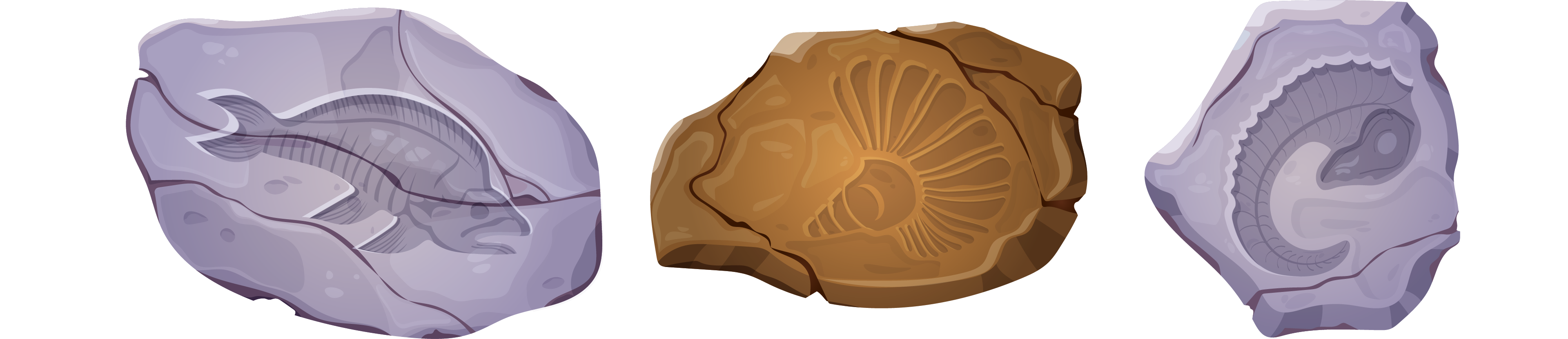
Most fossils are formed when the hard parts of organisms, like TEETH or SHELLS, are gradually replaced by minerals, creating a rock-like model of the original part.
2. Preservation:
When organisms die, microorganism feed on their bodies to cause them to DECAY. Some dead organisms however do not decay and can be preserved in areas where:
- No oxygen or moisture is present like AMBER or TAR PITS.
- Temperatures are too low for microorganisms to work like GLACIERS.
- pH is too acidic for microorganisms to work such as in PEAT BOGS.

3. Casts and Impressions:
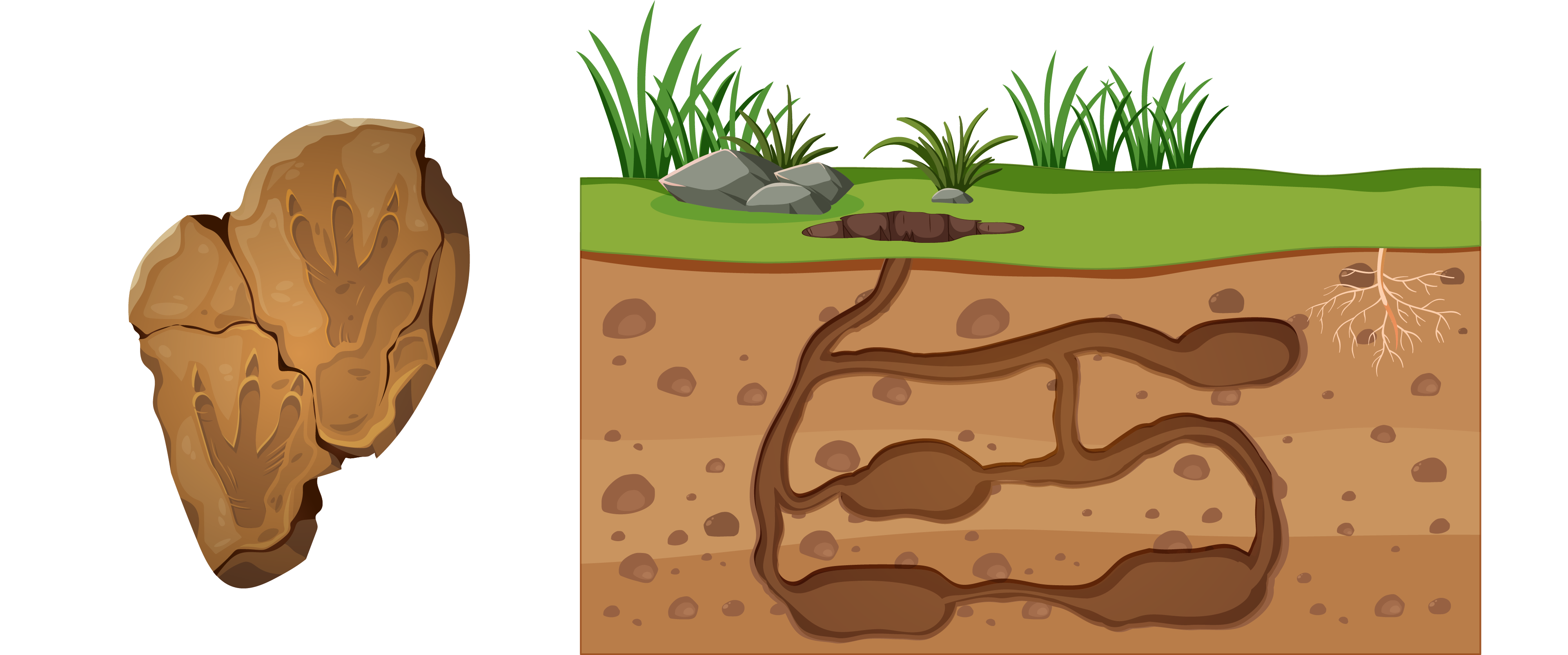
Not all fossils are of the organisms themselves. Some are TRACE FOSSILS, which record the ACTIVITY of organisms.
Examples of these include
- FOOTPRINTS of organisms in SOFT CLAY which later harden to preserve the shape
- ROOTLET TRACES that captures the imprint or remains of the fine, HAIR-LIKE ROOTS of ancient plants.
- BURROW TRACES which are tunnels and holes that record the ACTIVITY of animals (such as worms) that BURROWED into soft sediments in ancient environments.
THE SIGNIFICANCE OF FOSSILS
- Fossils give us a RECORD of past life on Earth and can give us an idea into the physical structure and lifestyle of extinct organisms.
- By looking at the GRADUAL CHANGES in organisms over time, they help scientists understand the process of EVOLUTION and how current species have developed from their ancestors.
- We can learn from fossils how much or how little different organisms have changed as life developed on Earth.
CHALLENGES WITH FOSSILS
- The main challenge with fossils is that the fossil record we have is INCOMPLETE.
- Scientist can NOT be certain about how life began on earth because many of the early forms of life were SOFT BODIED.
- This meant pretty much all of their bodies decayed and they left VERY LITTE TRACES behind.
- Any traces that happened to stay behind were destroyed by GEOLOGICAL ACTIVITY (e.g. tectonic plate movement).
EVOLUTIONARY TREES:
- These are diagrams that show how different species are related to each other.
- They show COMMON ANCESTORS and RELATIONSHIPS between species.
- Two branches in a tree meeting in an evolutionary tree represents a COMMON ANCESTOR.
- This means the CLOSER that two species share a BRANCH, the MORE RECENTLY they SHARE a common ancestor.
- The MORE RECENT the common ancestor, the MORE CLOSELY RELATED the two species. This means the two species are more likely to share MORE CHARACTERISTICS.
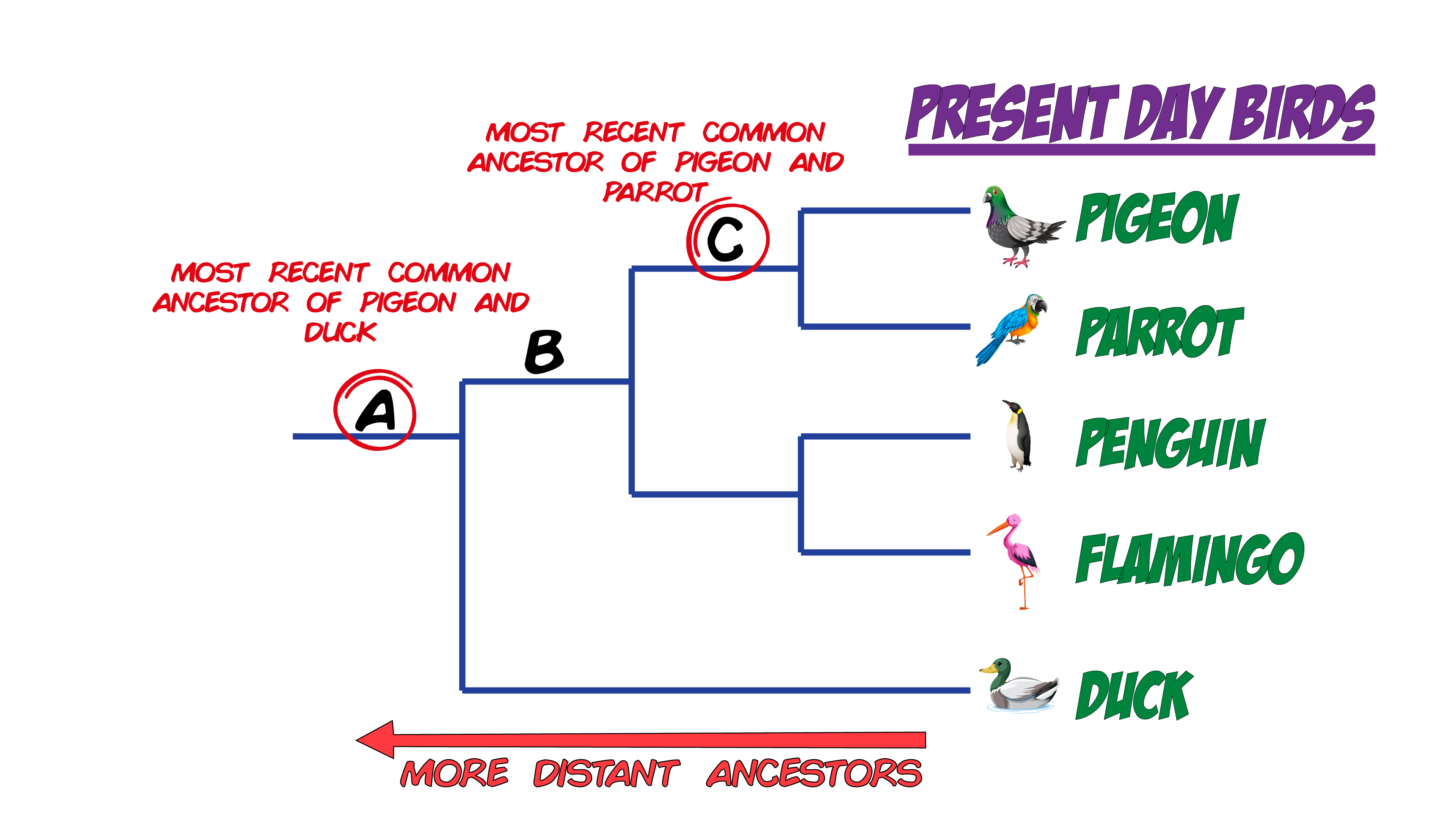
In this example, animals A, B and C are ancestors of the present day birds
PIGEONS are most closely related to PARROTS as they share the MOST RECENT ANCESTOR represented as animal C. This means they share MORE CHARACTERISTICS with each other (they are more similar).
PIGEONS will be LEAST related to DUCKS as their most recent common ancestor is more DISTANT (Animal A) so they will not share as many characteristic with them.
The bird in this diagram to evolve FIRST would be the DUCK as it branches off the EARLIEST compared to the other birds. It has directly evolved from animal A which is the earliest ancestor in the diagram.