
Maintaining Water and Nitrogen Balance in the Body
The levels of WATER, IONS and UREA in the body need to be controlled:
Water:
WATER is taken into the body through food and drink, and leaves the body through URINE, SWEAT and during EXHALATION (breathing out).
TOO MUCH water in the body can cause water to ENTER BODY CELLS by OSMOSIS causing the cell to BURST.
TOO LITTLE water in the body can cause water to LEAVE BODY CELLS by OSMOSIS causing the cell to SHRINK.
Ions:
Ions are taken into the body through food and drink, and leaves the body through URINE and SWEAT.
TOO MANY ions in the body can cause water to LEAVE BODY CELLS by OSMOSIS causing the cell to SHRINK.
TOO LITTLE ions in the body can cause water to ENTER BODY CELLS by OSMOSIS causing the cell to BURST.
Urea:
When PROTEINS from food are DIGESTED, they break down into AMINO ACIDS.
EXCESS amino acids that aren't used CANNOT be stored in the body so they need to be excreted safely.
In the liver these amino acids are DEAMINATED to form AMMONIA. However, ammonia is TOXIC and so it is immediately converted to UREA for safe excretion.
The UREA leaves the body through URINE and SWEAT.
There is NO CONTROL over WATER, IONS or UREA by the LUNGS through EXHALATION or the SKIN through SWEATING.
However, the levels of WATER, IONS and UREA can be controlled by the KIDNEYS through URINE.
The Kidneys
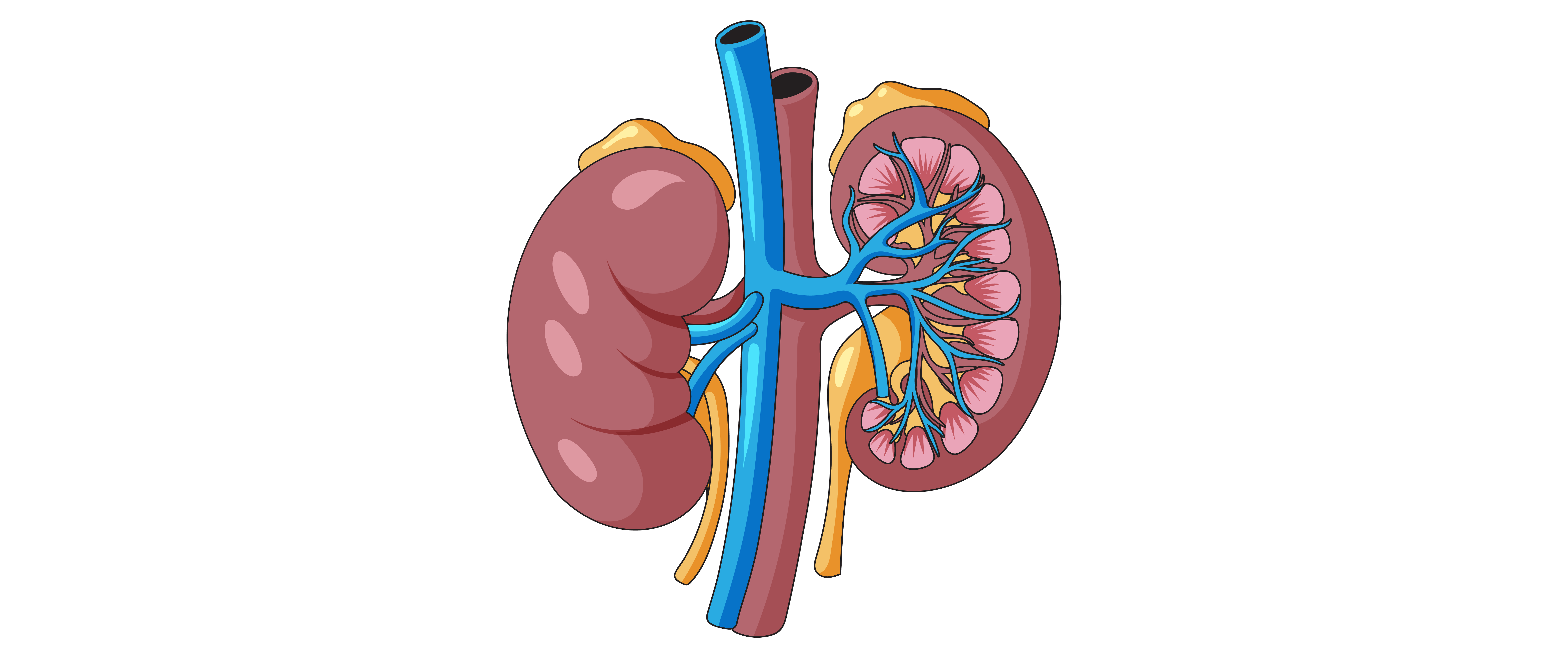
The KIDNEYS play a crucial role in the excretion of excess water, ions, and urea, which is eliminated through urine.
The KIDNEYS produces URINE in TWO steps:
1. FILTRATION (Ultrafiltration):
The blood is FILTERED and WATER, IONS, GLUCOSE and UREA are all removed from it.
2. SELECTIVE REABSORPTION:
Some of the substances that were removed are REABSORBED back into the BLOOD- but only the ones that the body needs:
- ALL of the GLUCOSE is reabsorbed back
- SOME of the WATER is reabsorbed back (only if the body needs it)
- SOME of the IONS are reabsorbed back (only if the body needs it)
- NONE of the UREA is reabsorbed back
Any of the substances that are NOT reabsorbed back into the blood, form URINE and it is EXCRETED from the body.
ADH and Water Content Control
ANTIDIURETIC HORMONE (ADH) is produced in the PITUITARY GLAND and plays a vital role in regulating water levels in the body.
It causes the KINDEY TUBULES to become MORE PERMEABLE, which results in MORE WATER being REABSORBED back into the blood and LESS being excreted as URINE.
The water content in the body is controlled with a NEGATIVE FEEDBACK MECHANISM.
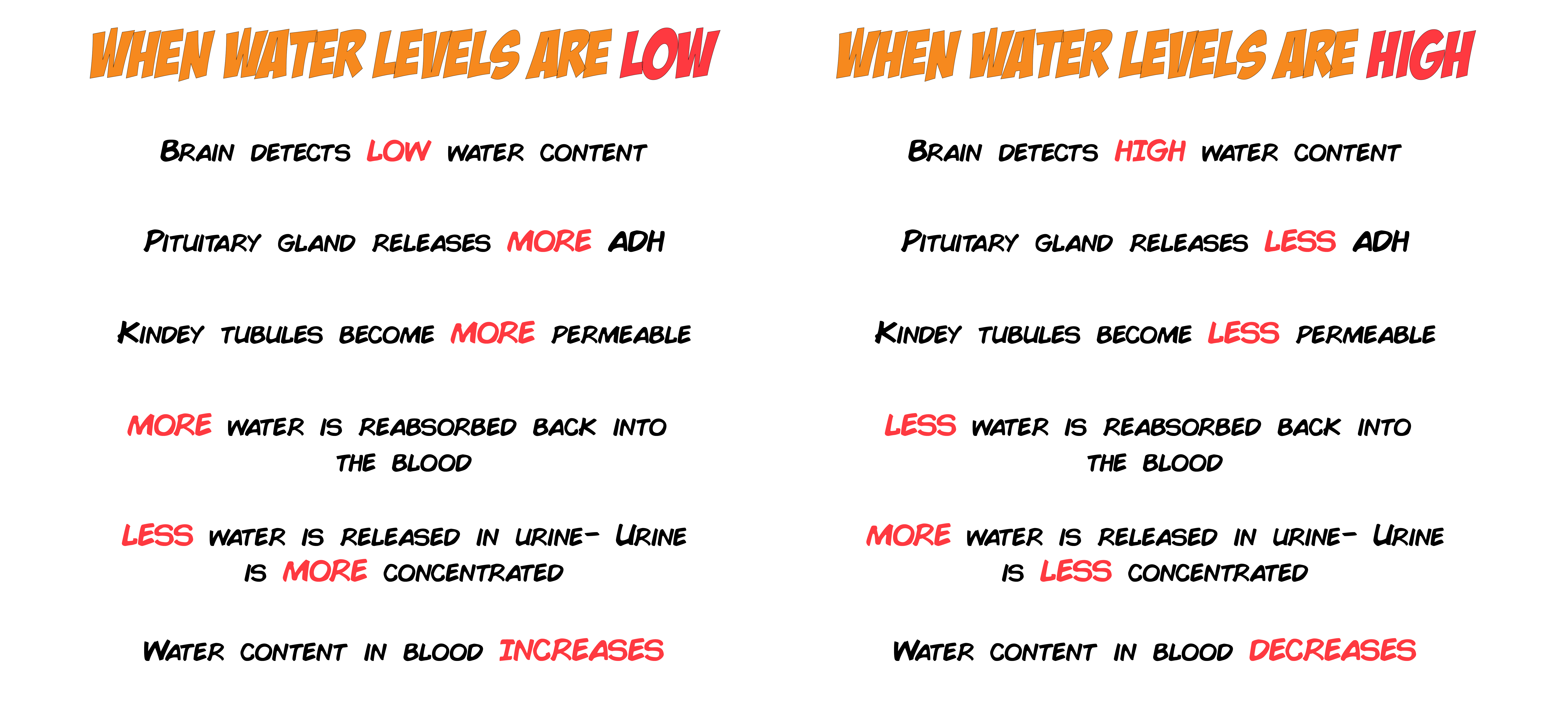
WHEN WATER LEVELS ARE LOW
1. The BRAIN detects LOW water content.
2. The PITUITARY GLAND releases MORE ADH (Antidiuretic Hormone).
3. KIDNEY TUBULES become MORE PERMEABLE.
4. MORE WATER is reabsorbed back into the BLOOD.
5. LESS WATER is released in urine—urine is MORE CONCENTRATED.
6. WATER CONTENT in BLOOD INCREASES.
WHEN WATER LEVELS ARE HIGH
1. The BRAIN detects HIGH water content.
2. The PITUITARY GLAND releases LESS ADH.
3. KIDNEY TUBULES become LESS PERMEABLE.
4. LESS WATER is reabsorbed back into the BLOOD.
5. MORE WATER is released in urine—urine is LESS CONCENTRATED.
6. WATER CONTENT in BLOOD DECREASES.
Kidney Failure
If a person's kidneys do not function properly, waste substances can build up in the blood, which can lead to death.
People with KIDNEY FAILURE can be treated with two methods:
1. DIALYSIS
DIALYSIS involves taking the patients blood and FILTERING it using a DIALYSIS MACHINE.
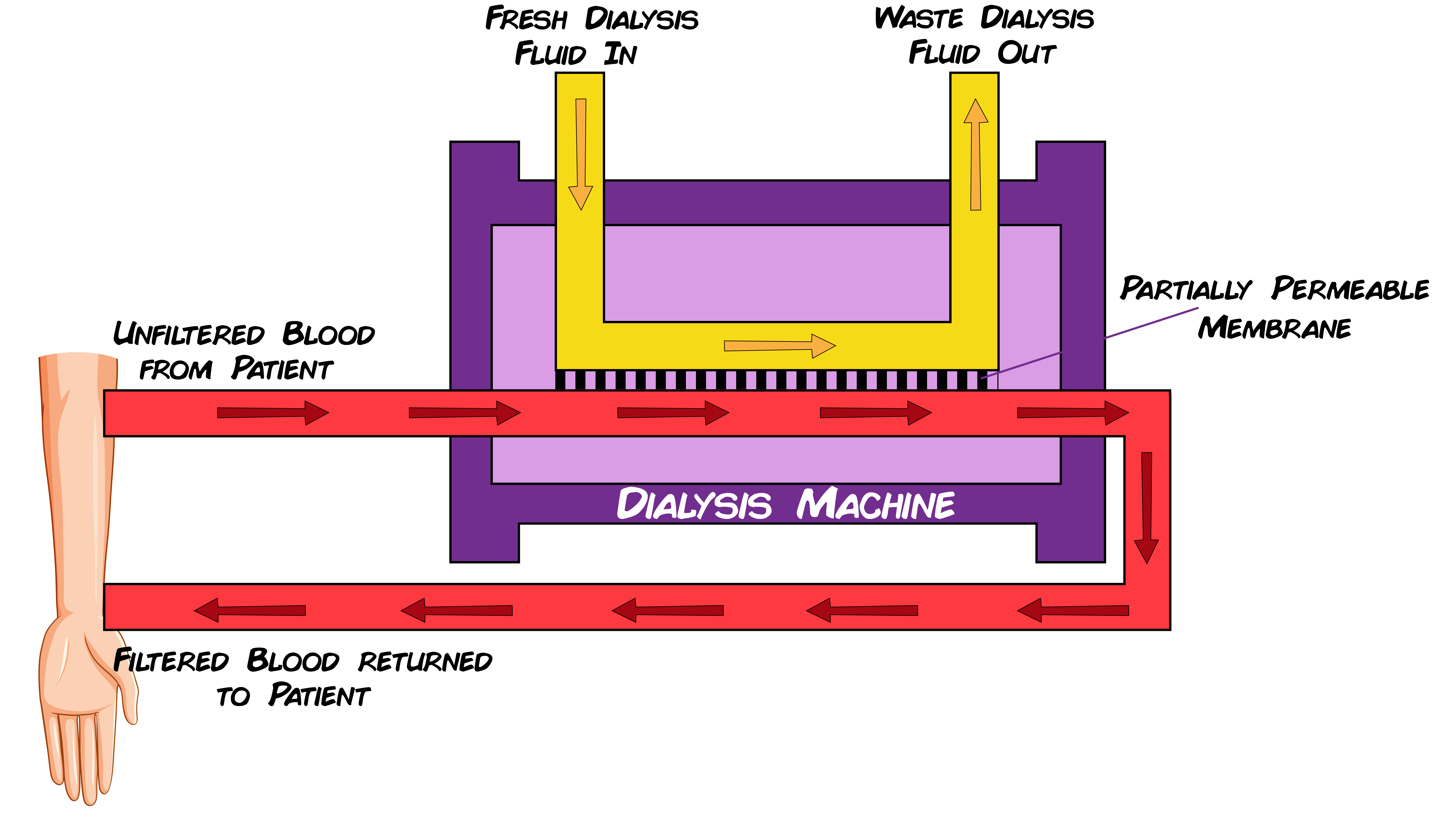
In a DIALYSIS MACHINE, blood flows between PARTIALLY PERMEABLE MEMBRANES, allowing the passage of IONS and WASTE SUBSTANCES, but not BIG MOLECULES like proteins.
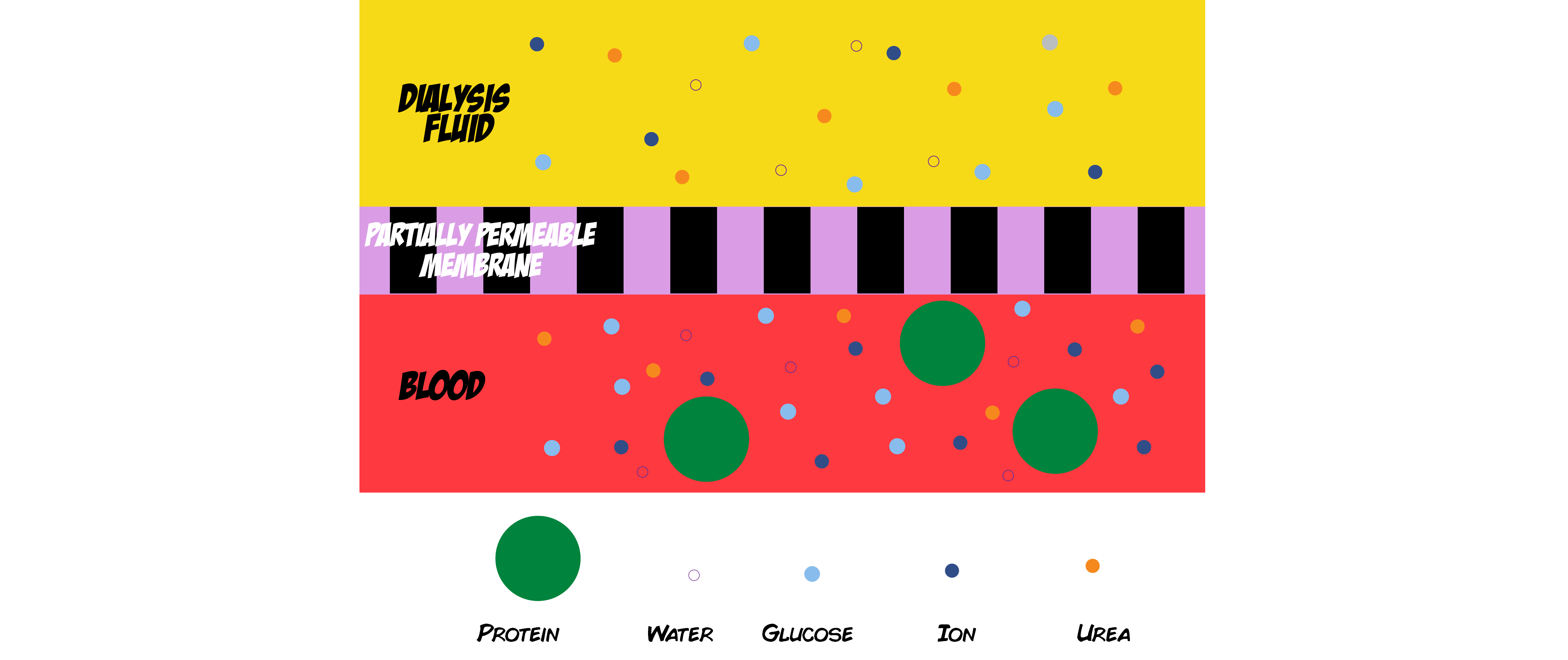
LARGE molecules like PROTEIN do NOT pass into the dialysis fluid as they are TOO LARGE to pass through the PARTIALLY PERMEABLE MEMBRANE.
The DIALYSIS FLUID has the same concentration of DISSOLVED SUBSTANCES as HEALTHY BLOOD, ensuring no loss of essential substances when the substances are transferred by DIFFUSION.
When the blood and dialysis fluid flow past the partially permeable membrane:
- ALL of the UREA is removed from the blood (as the dialysis fluid has NO urea)
- NONE of the GLUCOSE is removed from the blood (as the dialysis fluid has HIGH concentrations of glucose)
- EXCESS WATER is removed (as the dialysis fluid has healthy levels of water)
- EXCESS IONS are removed (as the dialysis fluid has healthy levels of ions)
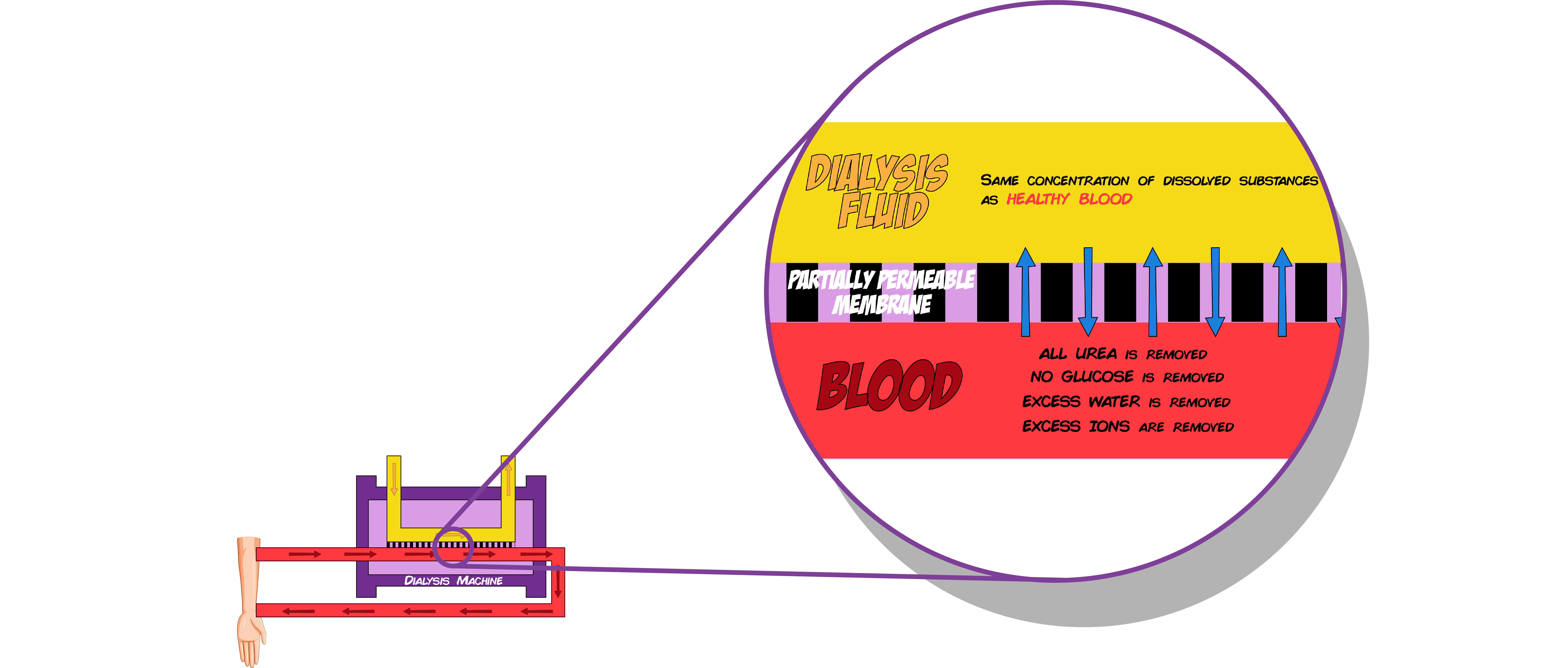
This setup ensures that only WASTE SUBSTANCES like UREA and EXCESS IONS AND WATER are filtered out.
DIALYSIS must be done REGULARLY to maintain NORMAL LEVELS of DISSOLVED SUBSTANCES in the blood and remove WASTE SUBSTANCES.
DIALYSIS SESSIONS typically occur THREE TIMES A WEEK, each lasting 3-4 HOURS which can be inconvenient.
Challenges include potential BLOOD CLOTS or INFECTIONS, and dialysis is costly for healthcare systems but extends life until a DONOR ORGAN is available.
2. KIDNEY TRANSPLANTS
The only definitive cure for kidney failure is a KIDNEY TRANSPLANT, typically from donors who are deceased or living relatives.
Donors must either be registered on an ORGAN DONOR REGISTER or carry a DONOR CARD.
Transplants, while cheaper in the long run, can be rejected by the recipient’s IMMUNE SYSTEM. DRUGS are used to prevent rejection, though it may still occur.
TRANSPLANTS reduce the hours spent in dialysis and improve quality of life but come with the risk of organ REJECTION and complications.