
Particle Motion in Gases
GASES consist of a large number of small particles, which are molecules or atoms. These particles are in CONSTANT RANDOM MOTION and move in straight lines until they collide with either the container walls or other particles.

Temperature
- As the TEMPERATURE of a gas rises, so does the SPEED of its molecules. This is because temperature is a measure of the AVERAGE KINETIC ENERGY of the molecules in a substance.
- If we keep the VOLUME of the gas constant and increase the temperature, the kinetic energy will increase. Higher kinetic energy means the molecules move faster.
Pressure
- PRESSURE in a gas is the result of COLLISIONS between the gas MOLECULES and the CONTAINER WALLS.
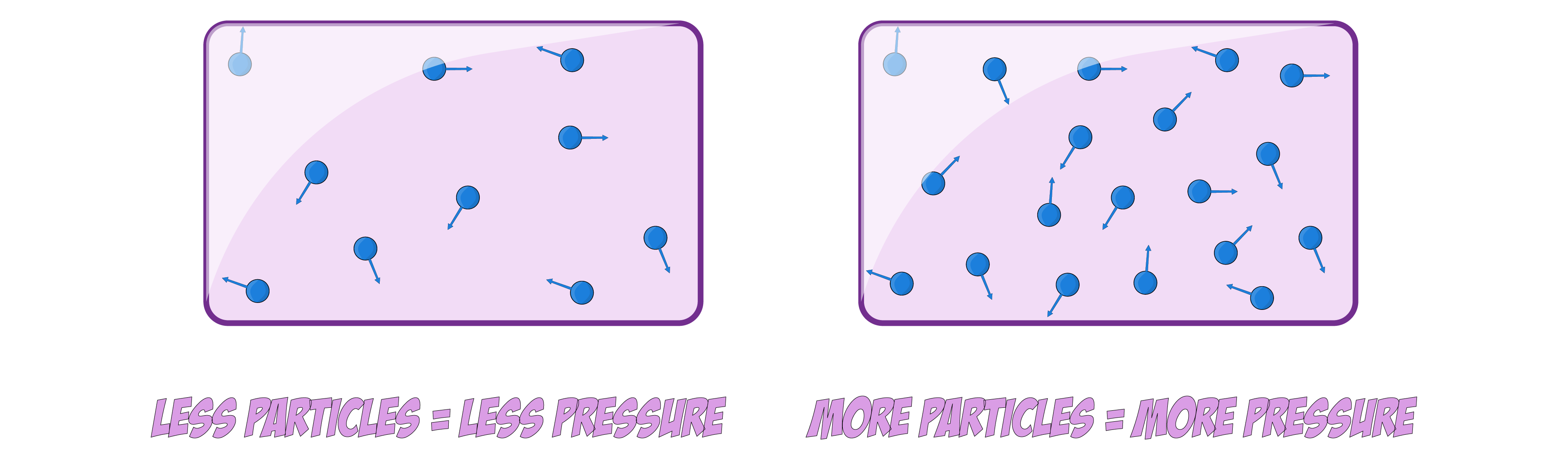
- The MORE MOLECULES you have in a given volume, the HIGHER the pressure.
- This is because gas molecules collide MORE FREQUENTLY and with GREATER FORCE against the container walls.
- The UNITS for pressure can be measured in (Pascals) Pa or (Atmospheres) atm.
Temperature-Pressure Relationship
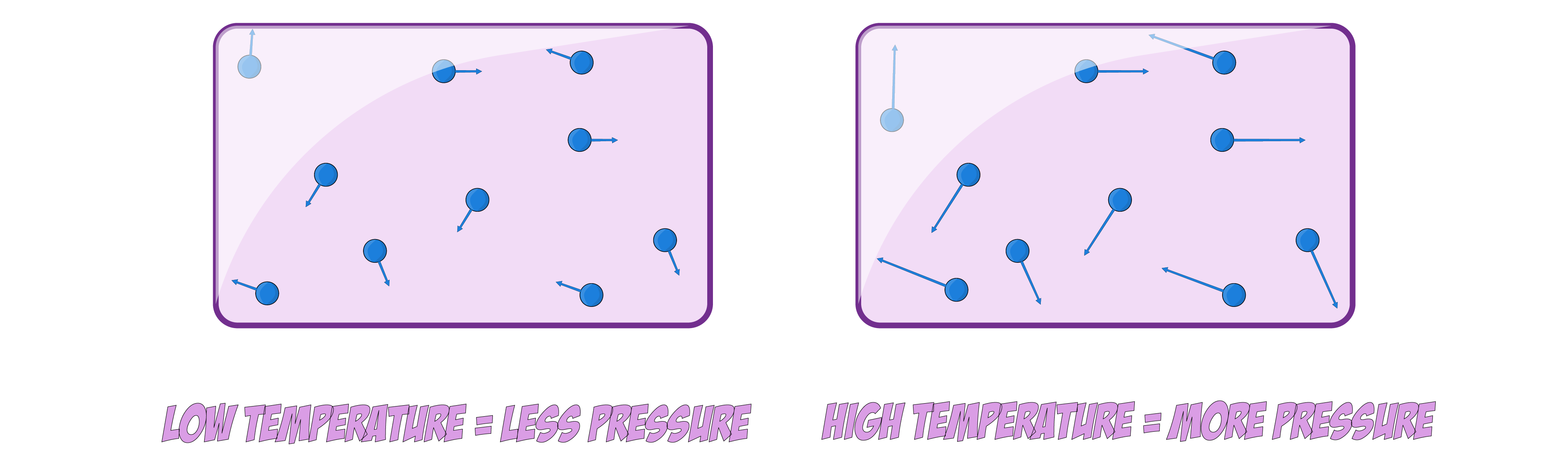
- If we heat a gas up, the molecules gain KINETIC ENERGY and move at HIGHER SPEEDS, leading to MORE FREQUENT and FORCEFUL collisions with the container walls, which INCREASES the PRESSURE.
- Therefore, at a CONSTANT VOLUME, an INCREASE in TEMPERATURE will lead to an INCREASE in PRESSURE.