
Tests for Ions
IONIC COMPOUNDS are made up of TWO oppositely charge IONS (anions and cations).
You can identify which ions are present in an IONIC COMPOUND using several tests:
Flame Tests

When compounds of certain metals are heated, they exhibit a CHARACTERISTIC colour in a flame. This is useful for identifying specific METAL IONS:
LITHIUM IONS (Li+): Crimson flame
SODIUM IONS (Na+): Yellow flame
POTASSIUM IONS (K+): Lilac flame
CALCIUM IONS (Ca2+): Orange-red flame
COPPER IONS (Cu2+): Green flame
To perform a flame test:
- Clean a METAL WIRE by dipping it in ACID and placing it into a BLUE bunsen burner flame.
- Dip the METAL WIRE into the sample to be tested.
- Place the metal wire into a BLUE Bunsen burner flame again.
- Observe and record the colour of the flame.
Note: The flame test is best for samples containing a SINGLE metal ion, as the presence of MULTIPLE metal ions can MASK the colours.
Precipitation Tests
Many compounds form as COLOURED PRECIPITATES when sodium hydroxide solution is added.
This is because the METAL IONS in the compounds form METAL ION HYDROXIDES which are INSOLUBLE.
To perform the test, ADD SODIUM HYDROXIDE to the compound and observe the colour of the precipitate formed.
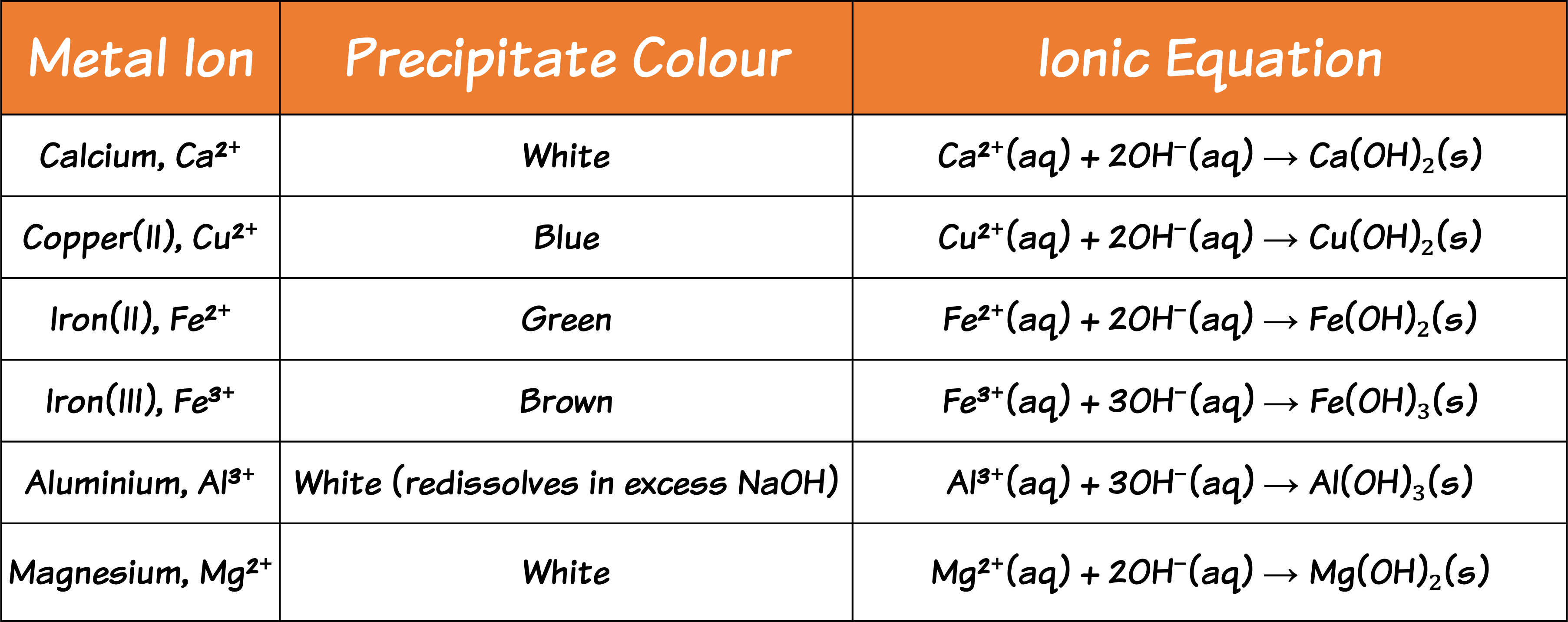
CALCIUM IONS (Ca2+): White precipitate of calcium hydroxide [Ca(OH)2]
COPPER(II) IONS (Cu2+): Blue precipitate of copper(II) hydroxide [Cu(OH)2]
IRON(II) IONS (Fe2+): Green precipitate of iron(II) hydroxide [Fe(OH)2]
IRON(III) IONS (Fe3+): Brown precipitate of iron(III) hydroxide [Fe(OH)3]
ALUMINIUM IONS (Al3+): White precipitate of aluminium hydroxide [Al(OH)3] at first, but RE-DISSOLVES in excess NaOH to form a colourless solution
MAGNESIUM IONS (Mg2+): White precipitate of magnesium hydroxide [Mg(OH)2]
Test for Carbonates (CO32-)
To test for a carbonate, first react it with DILUTE ACID and it will form CARBON DIOXIDE.
You can test the presence of CARBON DIOXIDE by bubbling it through LIMEWATER to maknig it go CLOUDY.
Test for Halides (Cl-,Br-,I-)
To test for halides like CHLORIDES, BROMIDES and IODIDES, you can add DILUTE NITRIC ACID and SILVER NITRATE solution.
- CHLORIDES (Cl-) form a WHITE precipitate.
- BROMIDES (Br-) form a CREAM precipitate.
- IODIDES (I-) form a YELLOW precipitate.
Test for Sulfates (SO42-)
To test for SULFATES, add DILUTE HYDROCHLORIC ACID and BARIUM CHLORIDE solution and it will form a WHITE PRECIPITATE.