Limiting Reactants
In chemical reactions, you can have an EXCESS reactant and a LIMITING reactant.
When you have an EXCESS of a reactant, you have MORE of it than needed for the reaction. They are used to ensure another reactant is completely used up.
The LIMITING REACTANT is the substance that is COMPLETELY USED UP before the EXCESS REACTANT.
When the LIMITING REACTANT gets used up, the reaction STOPS meaning the EXCESS REACTANT would remain without reacting.
The AMOUNT OF PRODUCT that can be formed depends on the AMOUNT OF LIMITING REACTANT.
When performing reacting mass calculations, the LIMITING REAGENT is always the number that should be used, as it indicates the maximum possible amount of product that can form.
Determining the Limiting Reactant
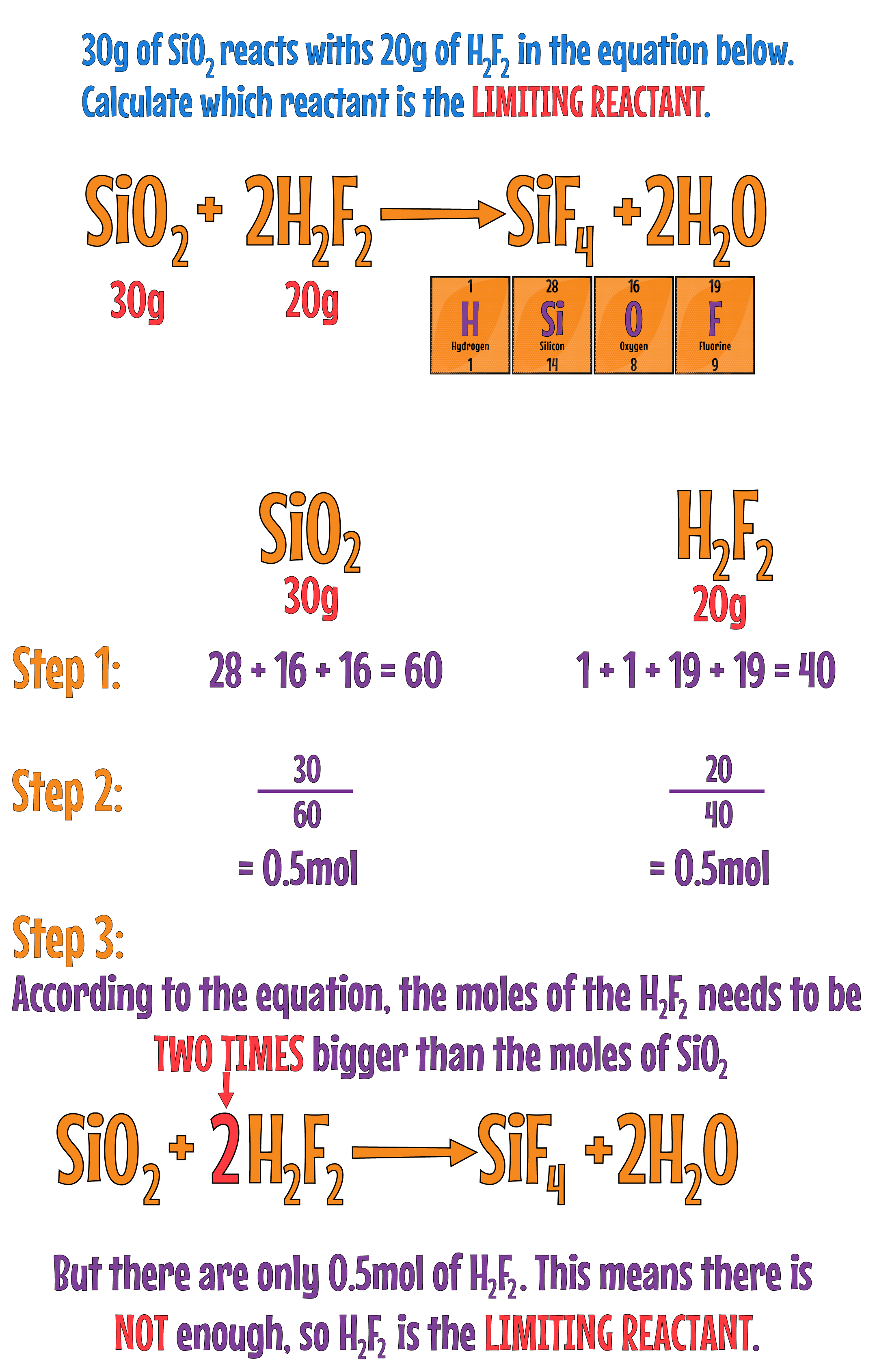
In order to determine which reactant is the limiting reagent in a reaction, you have to use the AMOUNTS of each reactant used and the MOLAR RATIO of the balanced chemical equation.
To calculate the limiting reactant:
Step 1:
Find the Mr of each reactant.
Step 2:
CONVERT the mass of each reactant into MOLES by dividing by the Mr.
Step 3:
Compare the moles with the BALANCED EQUATION to see whether the moles match the ratio.
Let's use these steps in an example: