
Relative Formula Mass and Percentage Composition
RELATIVE FORMULA MASS
RELATIVE FORMULA MASS (Mr) is the SUM of the RELATIVE ATOMIC MASSES (Ar) of all the atoms in a chemical formula. Here's how to calculate it:
- Find the RELATIVE ATOMIC MASSES (Ar) of each element in the compound (usually listed in the periodic table).
- Multiply the Ar of each element by the NUMBER OF ATOMS of that element in the formula.
- Add these values together to get the Mr of the compound.
For example:
The Mr of CaF2 is calculated as:

Here are a few more examples:
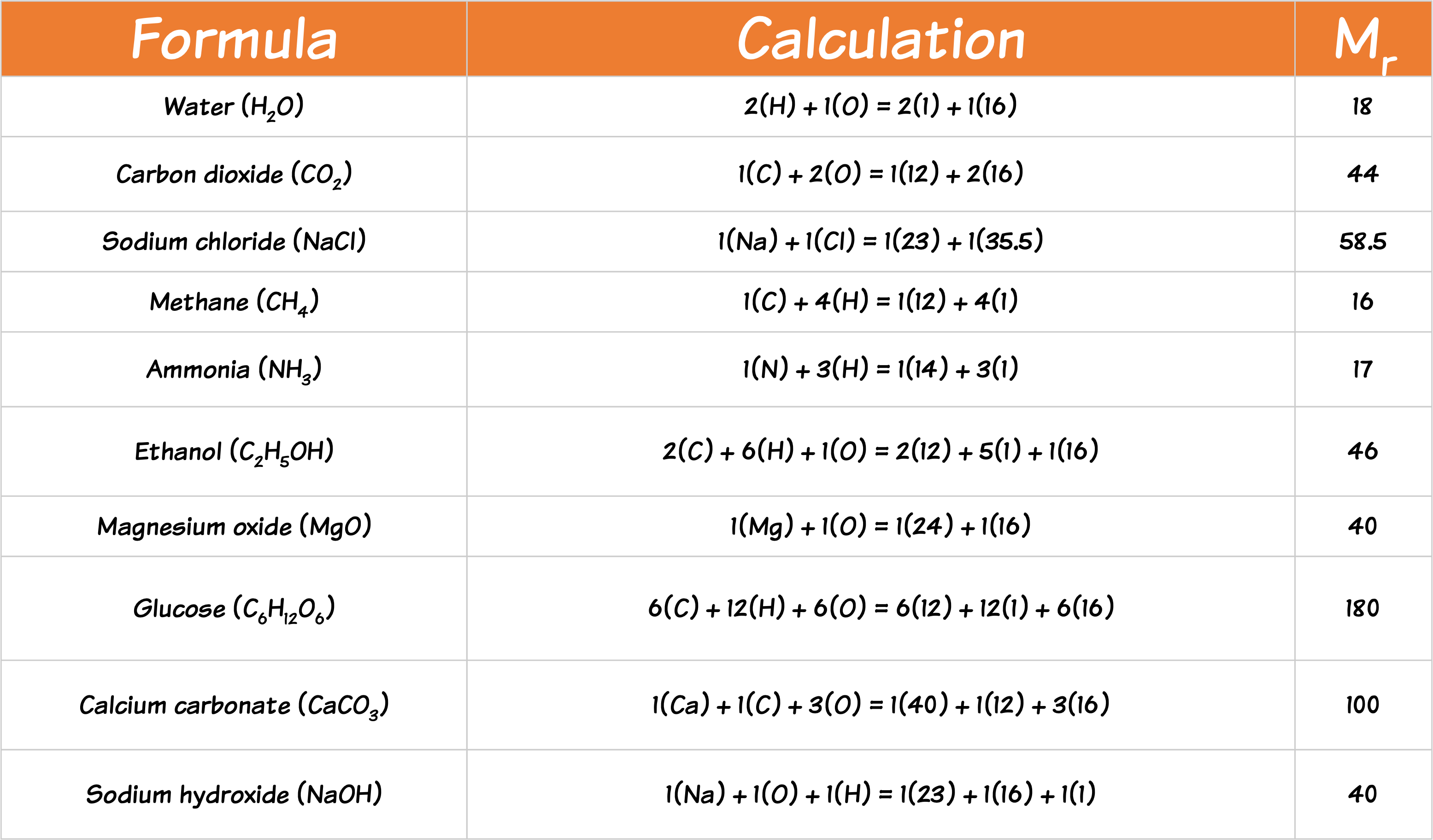
In a balanced chemical equation, the sum of the relative formula masses of the reactants equals the sum of the relative formula masses of the products.
CALCULATING THE PERCENTAGE MASS OF AN ELEMENT IN A COMPOUND
To find the percentage mass of an element in a compound:
- MULTIPLY the RELATIVE ATOMIC MASSES (Ar) of the element by the number of atoms of that element in the compound.
- DIVIDE this by the RELATIVE FORMULA MASS (Mr) of the whole compound.
- Multiply by 100 to convert to a percentage.
For example: The percentage mass of LITHIUM in Li2SO4:

Here are some more examples of finding the percentage of certain elements in compounds:
