States of Matter
Materials can exist in three states: SOLID, LIQUID, and GAS.
These states can be represented using a SIMPLE MODEL.
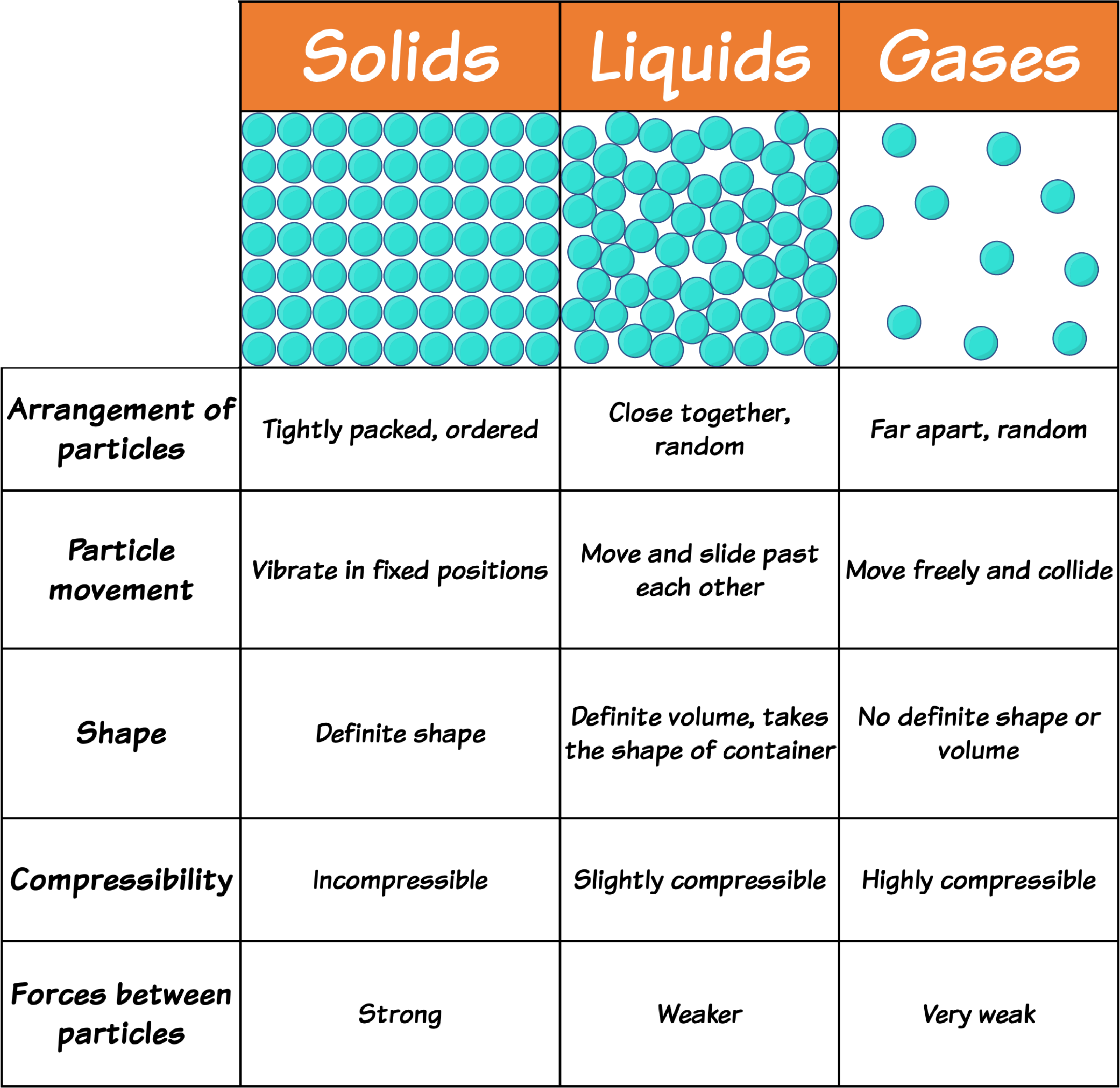
This SIMPLE MODEL explains the behaviour of particles in different states using the model of SMALL, INELASTIC SPHERES.
However, in reality, the particles aren’t SOLID, SPHERICAL or INELASTIC. The particles are atoms, ions or molecules.
The simple model does not show the ACTUAL FORCES between particles, so there is no way of knowing how strong they are.
Changing State
CHANGING STATE refers to the process where substances CHANGE between solid, liquid, and gas phases.
This process involves energy changes and particle movement. The amount of ENERGY needed to change state from solid to liquid and from liquid to gas depends on the STRENGTH of the forces between the particles of the substance.
Individual atoms themselves do not share the same properties as bulk matter.
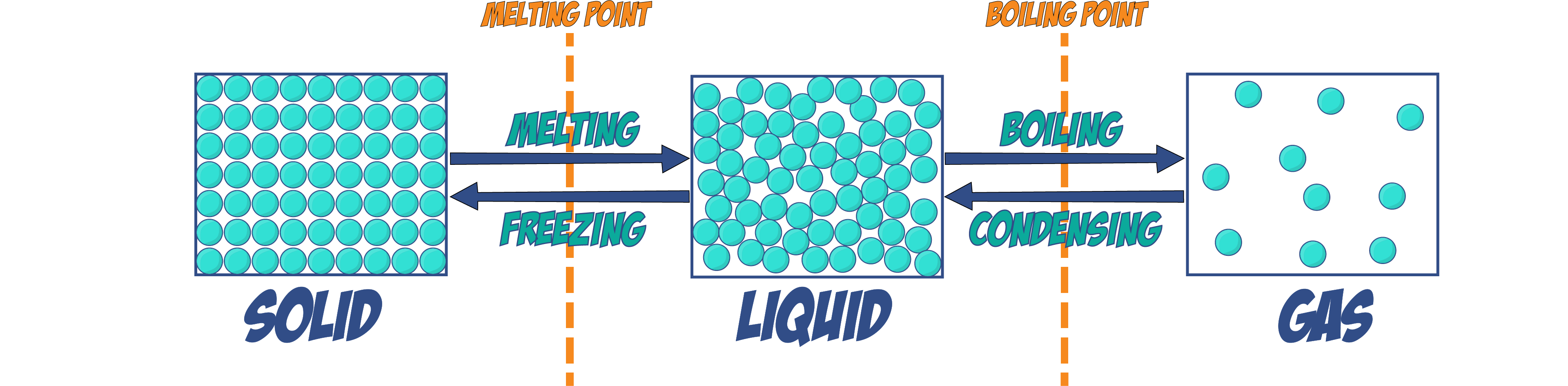
- HEATING A SOLID: When a solid is heated to its MELTING POINT, its particles gain energy and VIBRATE more, weakening the forces holding them together. This is known as MELTING.
- HEATING A LIQUID: Heating a liquid to its BOILING POINT gives particles more energy to move faster, leading to BOILING or EVAPORATING where the liquid becomes a gas.
- FREEZING: When the particles in a liquid are cooled to their MELTING POINT, they lose energy and move less, they form more bonds and the liquid becomes a solid. This is FREEZING.
- CONDENSING: A gas turns into a liquid when it is cooled to its BOILING POINT, as particles lose energy and form bonds.
Particle Theory:
Particle theory explains how matter changes state depending on the ENERGY and FORCES present between the particles in the substance.
- The amount of energy needed to change from a solid to a liquid and from a liquid to a gas depends on the STRENGTH of the FORCES between the particles.
- There are many different types of substances which contain different amounts of elements and compounds.
- Since each substance contains different particles, the amount of energy needed to change the state of them is DIFFERENT for each individual substance.
- The STRONGER the FORCES between the particles, the HIGHER the ENERGY needed for melting and boiling to occur.
- When substances are heated, the particles ABSORB heat energy which causes its particles to VIBRATE more.
- Eventually, when the substance reaches the MELTING POINT, the bonds between the particles break and the solid MELTS into a liquid.
- When it is heated further and the boiling point is reached, the particles gain enough energy for the forces between them to break and they turn into a GAS.
This theory is useful for understanding how changes of state work, but just like the simple model, it has its limitations:
- It assumes all particles to be SOLID, SPHERICAL and INELASTIC, when they aren’t.
- It doesn’t consider the differences caused by different particles, such as atoms, ions and molecules.
- It doesn't consider the INTERMOLECULAR forces between particles in different substances.
Predicting the State of a Substance
To predict the state of a substance:
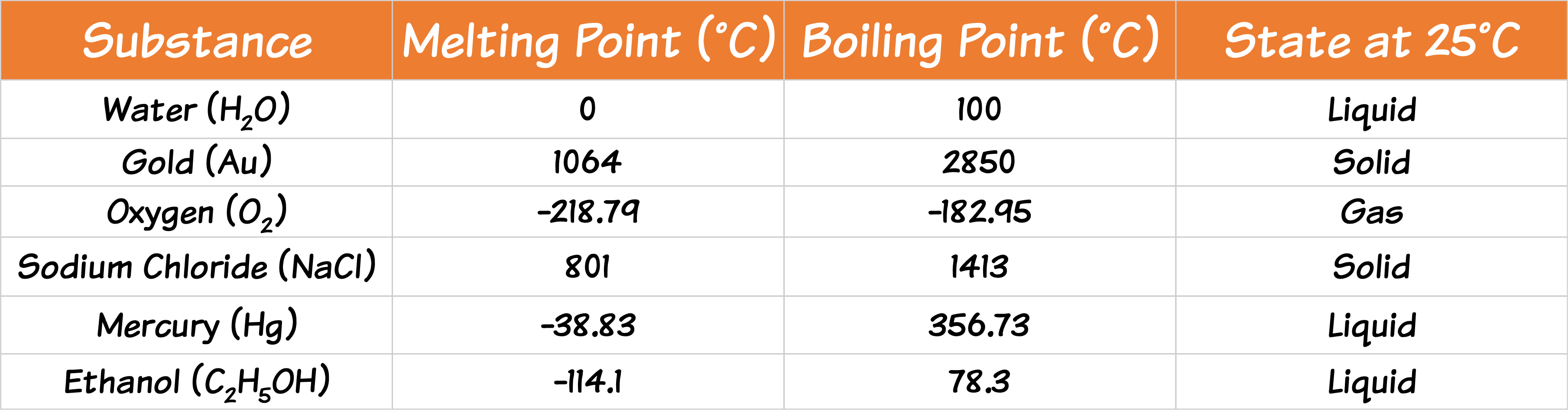
- BELOW the MELTING POINT, a substance is SOLID.
- ABOVE the BOILING POINT, it's a GAS.
- BETWEEN these two points, it's a LIQUID.
Let’s predict the states of the following substances at room temperature (25 °C):