Relative electrical charges of subatomic particles
- ATOMS are incredibly SMALL, and make up EVERYTHING in the universe.
- They are the SMALLEST part of an ELEMENT that can exist.
- They are composed of THREE even smaller particles known as SUB-ATOMIC PARTICLES: PROTONS, NEUTRONS, and ELECTRONS.
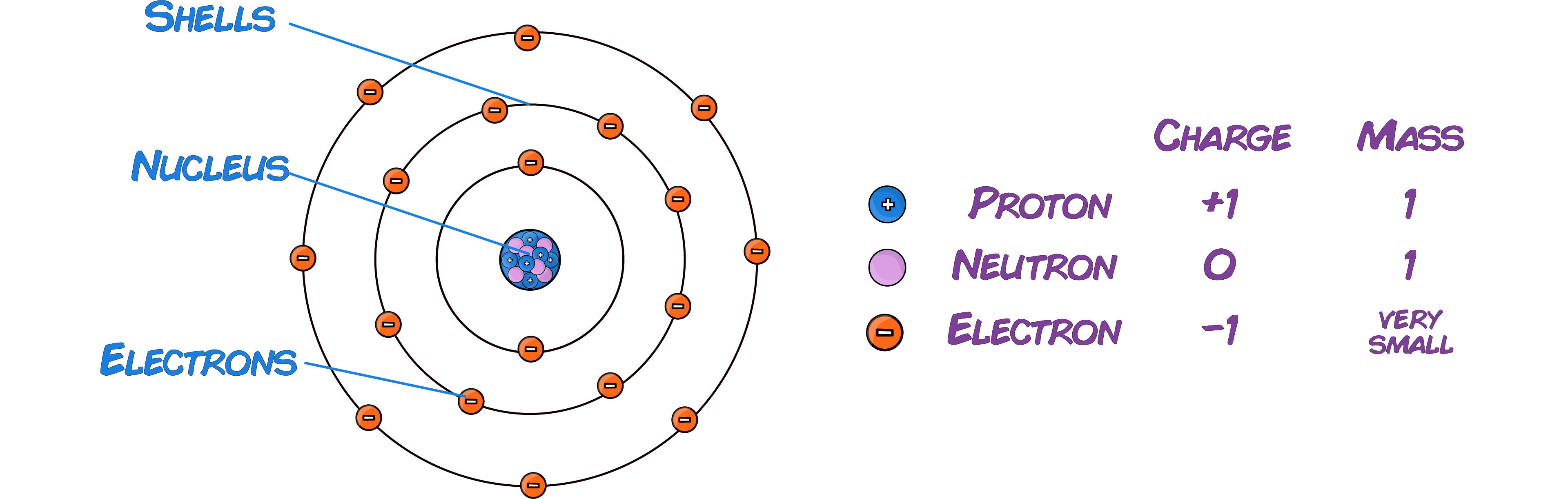
- At the center of an atom lies the NUCLEUS, containing PROTONS and NEUTRONS.
- PROTONS have a positive charge (+1) and a relative mass of 1.
- NEUTRONS have no charge (0) and a relative mass of 1, similar to protons.
- ELECTRONS orbit around the nucleus in electron shells.
- They are negatively charged (−1) and are VERY SMALL, with virtually no mass when compared to protons and neutrons.
- The NUCLEUS is tiny compared to the whole atom, about 1/10,000th of the atom's total size, but it holds nearly ALL the atom's mass.