
Atoms, Elements and Compounds
- ATOMS are incredibly SMALL, and make up EVERYTHING in the universe.
- They are the SMALLEST part of an ELEMENT that can exist.
- Atoms are NEUTRAL and have NO OVERALL CHARGE.
- This is because they have the SAME NUMBER OF PROTONS AND ELECTRONS, which CANCELS OUT THEIR CHARGES.
Chemical Symbols
- Atoms of each element are represented by a CHEMICAL SYMBOL which can be found in the PERIODIC TABLE. E.g. Carbon has the symbol C.
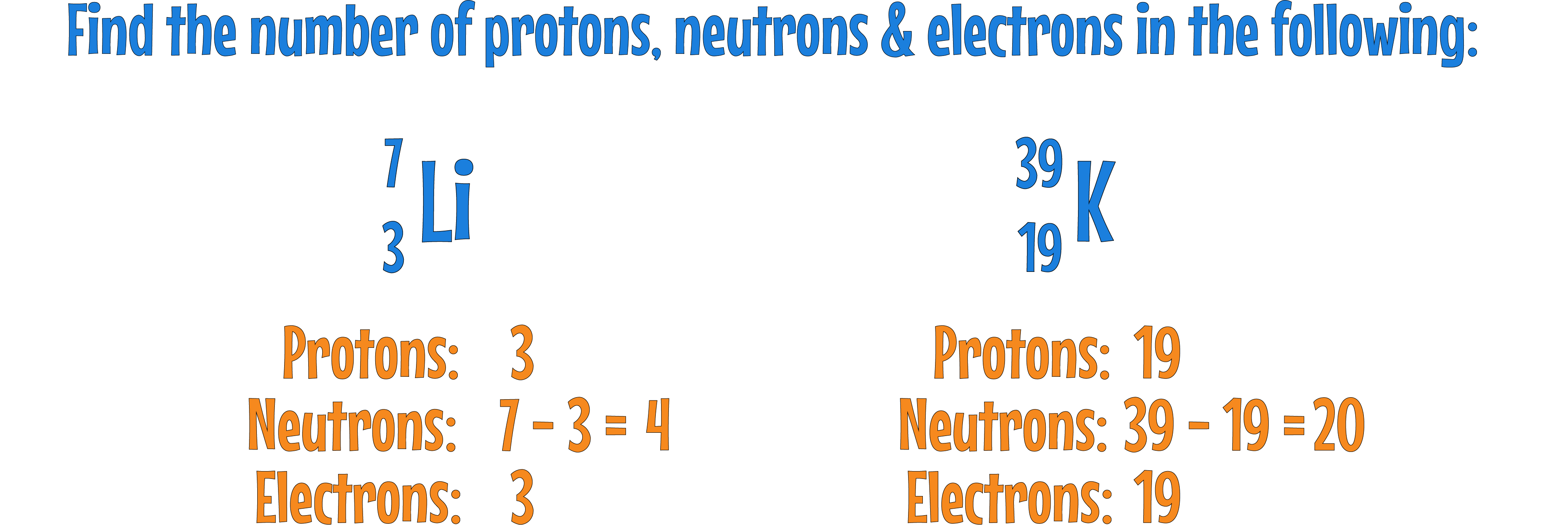
- They can be represented as below:

- The ATOMIC NUMBER indicates how many protons are in an atom's nucleus.
- The MASS NUMBER is the total count of both protons and neutrons.
- To find the number of NEUTRONS, SUBTRACT the atomic number from the mass number.
Elements:
- An ELEMENT is a substance made up of ONE TYPE OF ATOM.
- There are over 100 different discovered ELEMENTS which can all be found in the PERIODIC TABLE.
- All the atoms in an element contain the SAME NUMBER of PROTONS in their nucleus.
- When atoms have different numbers of PROTONS, they are classified as DIFFERENT elements.
- This means the ATOMIC NUMBER determines the ELEMENT of an atom. For example, Carbon atoms ALWAYS have 6 protons (has an atomic number of 6).
Isotopes
- All atoms of a particular ELEMENT have the same ATOMIC NUMBER but may have different numbers of NEUTRONS.
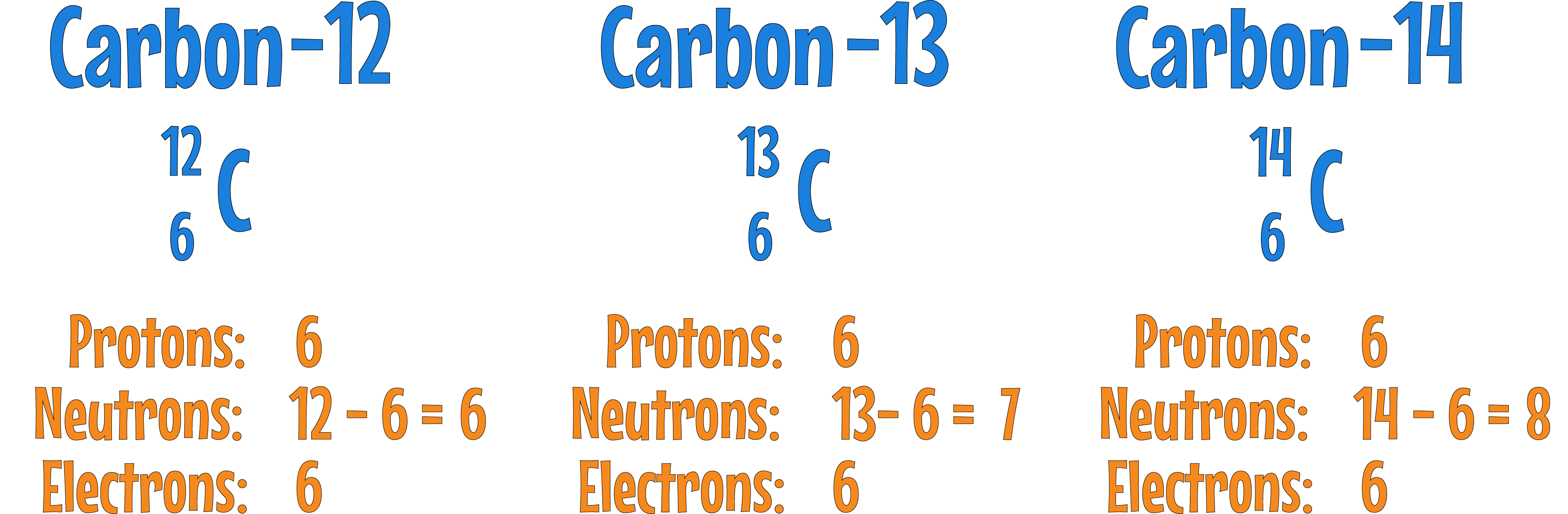
- ISOTOPES are different forms of the same element, having the SAME NUMBER OF PROTONS (same atomic number) but DIFFERENT NUMBERS OF NEUTRONS (different mass numbers).
- A common example is Carbon-12, Carbon-13 and Carbon-14 which all have six protons but differ in the number of neutrons:
Compounds
- COMPOUNDS are substances that form when two or more elements react and their atoms combine.
- These elements join in FIXED PROPORTIONS and are held together by CHEMICAL BONDS.
- In compounds, only the ELECTRONS are involved in bond formation while the nuclei remain unchanged.
- The PROPERTIES of a compound are usually quite different from the properties of the original elements.
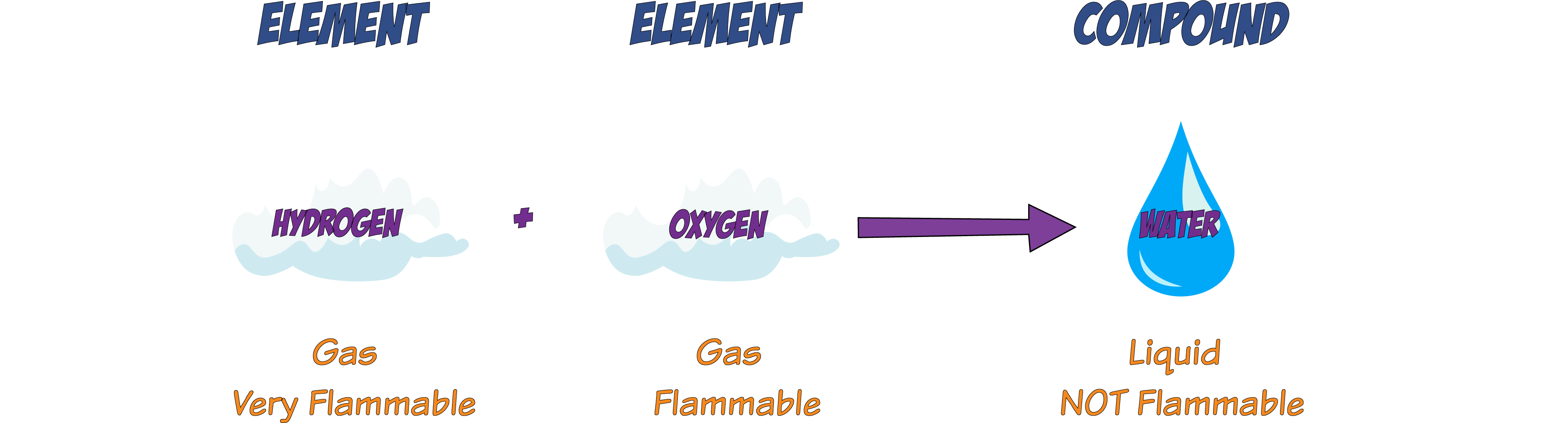
- For example, HYDROGEN is a colourless, odourless gas that is highly flammable, while OXYGEN is a colourless gas that can burn (combustion). When these two elements react, they form WATER (H₂O) which is a liquid at room temperature and does NOT BURN. The properties of water are entirely different from those of its constituent gases, hydrogen and oxygen.
Compound Formulas
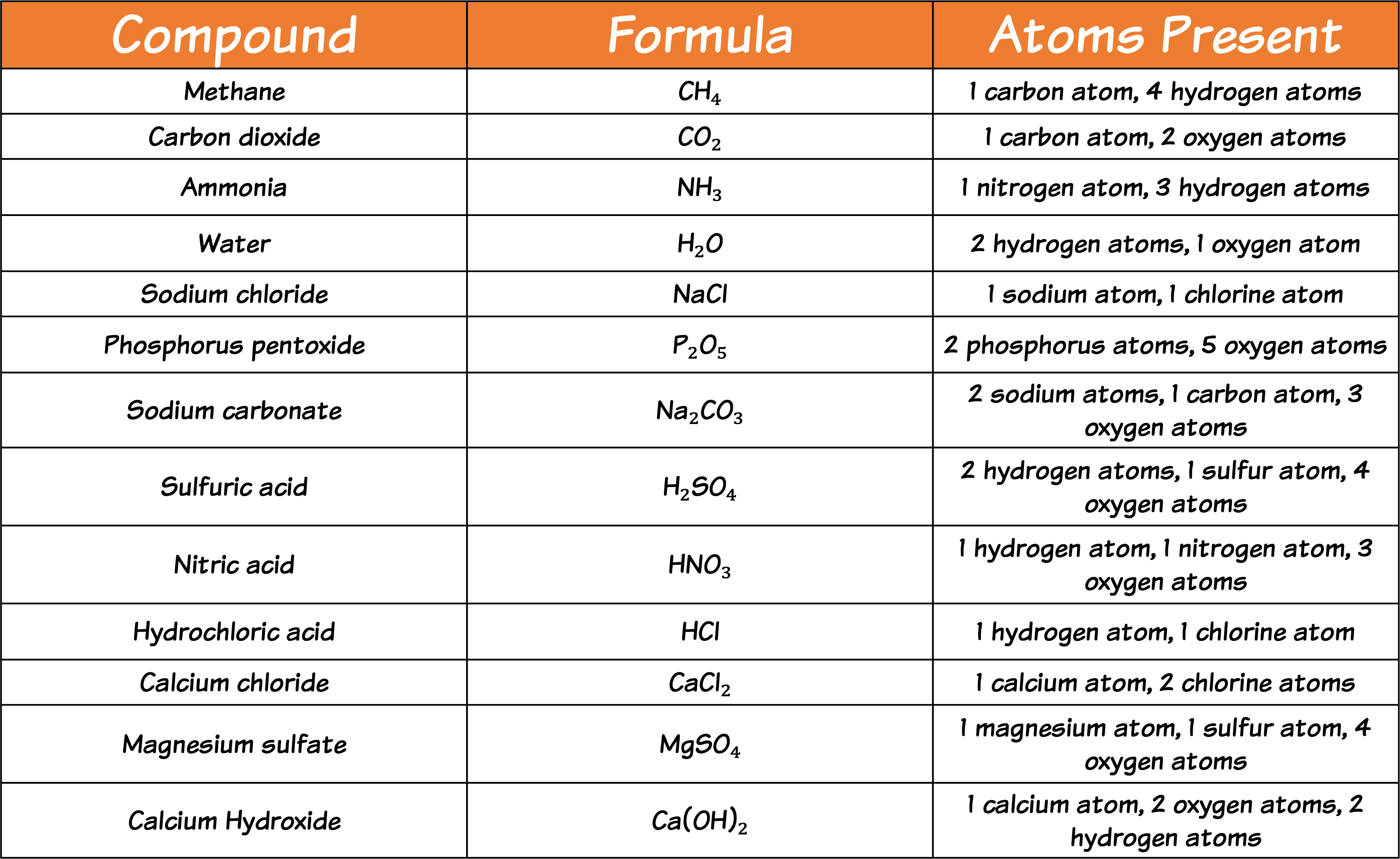
- FORMULAS represent compounds and show the elements and the number of atoms of each element in a compound.
- The formula for water is H₂O, indicating 2 hydrogen atoms and one oxygen atom.
- Some familiar compounds and their formulas include:
Chemical Equations
CHEMICAL EQUATIONS are used to show what happens during a chemical reaction. The LEFT hand side represents the REACTANTS and the RIGHT hand side represents the PRODUCTS.
- A WORD EQUATION expresses the reactants and products of a reaction in WORDS.
- A SYMBOL EQUATION is more CONCISE, using chemical symbols and FORMULAS to represent the reactants and products. For example, methane burning in oxygen can be written as:


However the symbol equation is NOT correct as it needs to be BALANCED.
Balancing Chemical Equations
- Symbol equations must be BALANCED, meaning they have the same number of each type of atom on both sides of the equation.
- To balance an equation, COEFFICIENTS (numbers in front of the formulas) are adjusted so that the number of ATOMS for each element is equal on both sides.
- The CONSERVATION OF MASS tells us that no atoms are LOST or GAINED in a chemical reaction, they are just REARRANGED.
- This means the equation needs to be BALANCED.
- To balance an equation you ADJUST the COEFFICIENTS until there are the SAME number of ATOMS of the SAME ELEMENT on each side.
Steps to Balance Equations
- Identify the number of atoms of EACH ELEMENT on either side of the equation.
- ADJUST the coefficients to balance that element, which may cause another element to become unbalanced.
- Repeat the process, adjusting coefficients as necessary until the equation is BALANCED.
Consider the reaction with methane and oxygen:

The Carbons are both balanced but the Hydrogens and the Oxygens are not.
You can put a 2 in front of WATER to make the reaction have 4 HYDROGENS on BOTH SIDES.

Now the Carbons and Hydrogens are both BALANCED but the Oxygens are NOT.
You can put a 2 in front of the OXYGEN to balance it.
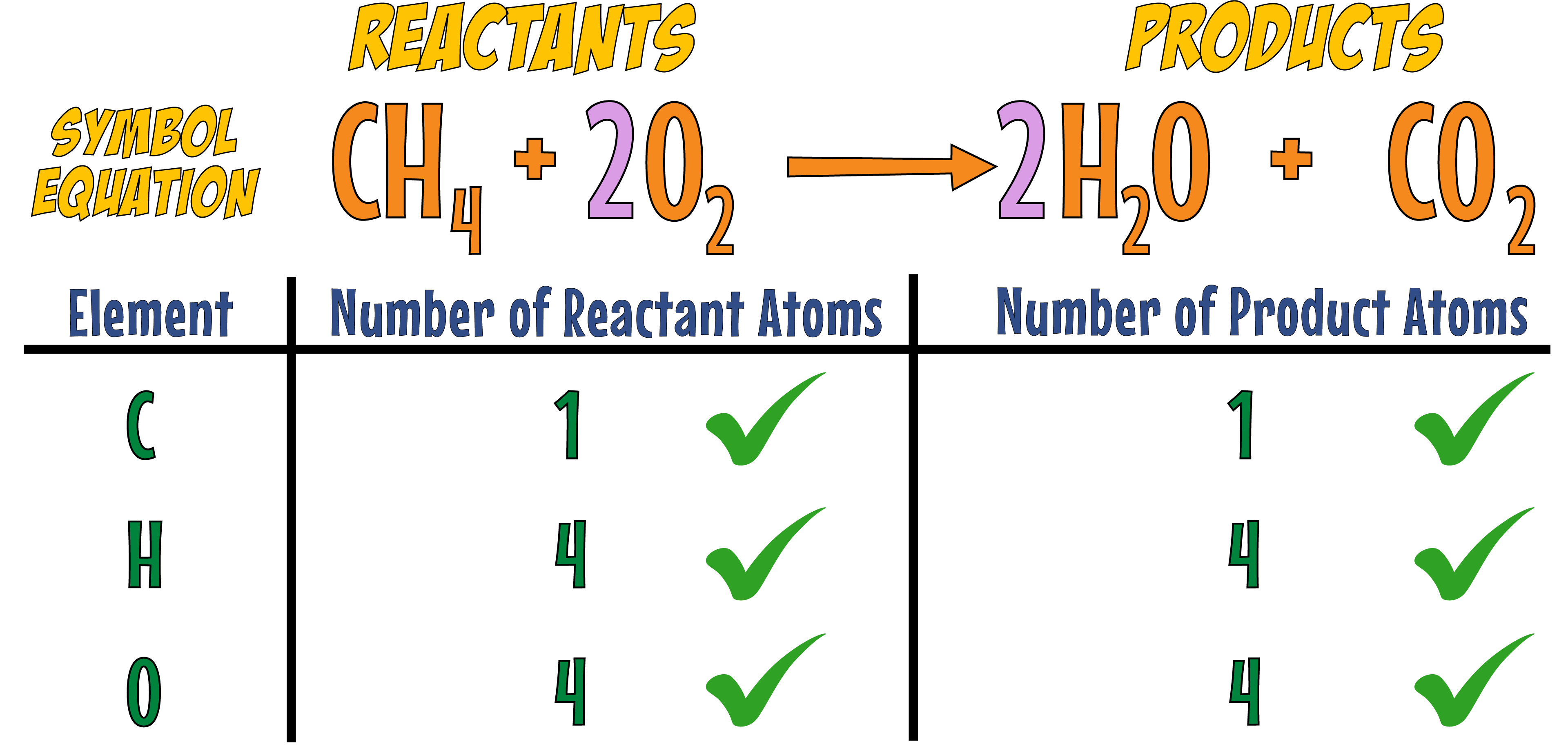
Now the equation is BALANCED.