
Selective Breeding
- SELECTIVE BREEDING or (ARTIFICIAL SELECTION) is a process where humans choose specific plants or animals with DESIRABLE TRAITS to BREED, in order to pass down the desirable characteristics to the offspring.
- The goal is to ensure that genes for particular traits stay in the population.
- This is something humans have been doing for thousands of years since they first bred FOOD CROPS from wild plants and DOMESTICATED ANIMALS (pets).
Examples of characteristics that humans choose for selective breeding include:
- DISEASE RESISTANT food crops.
- Animals which produce MORE MEAT or MILK.
- Domestic dogs (pets) with a GENTLE NATURE.
- LARGE or UNUSUAL decorative flowers.
STEPS IN SELECTIVE BREEDING
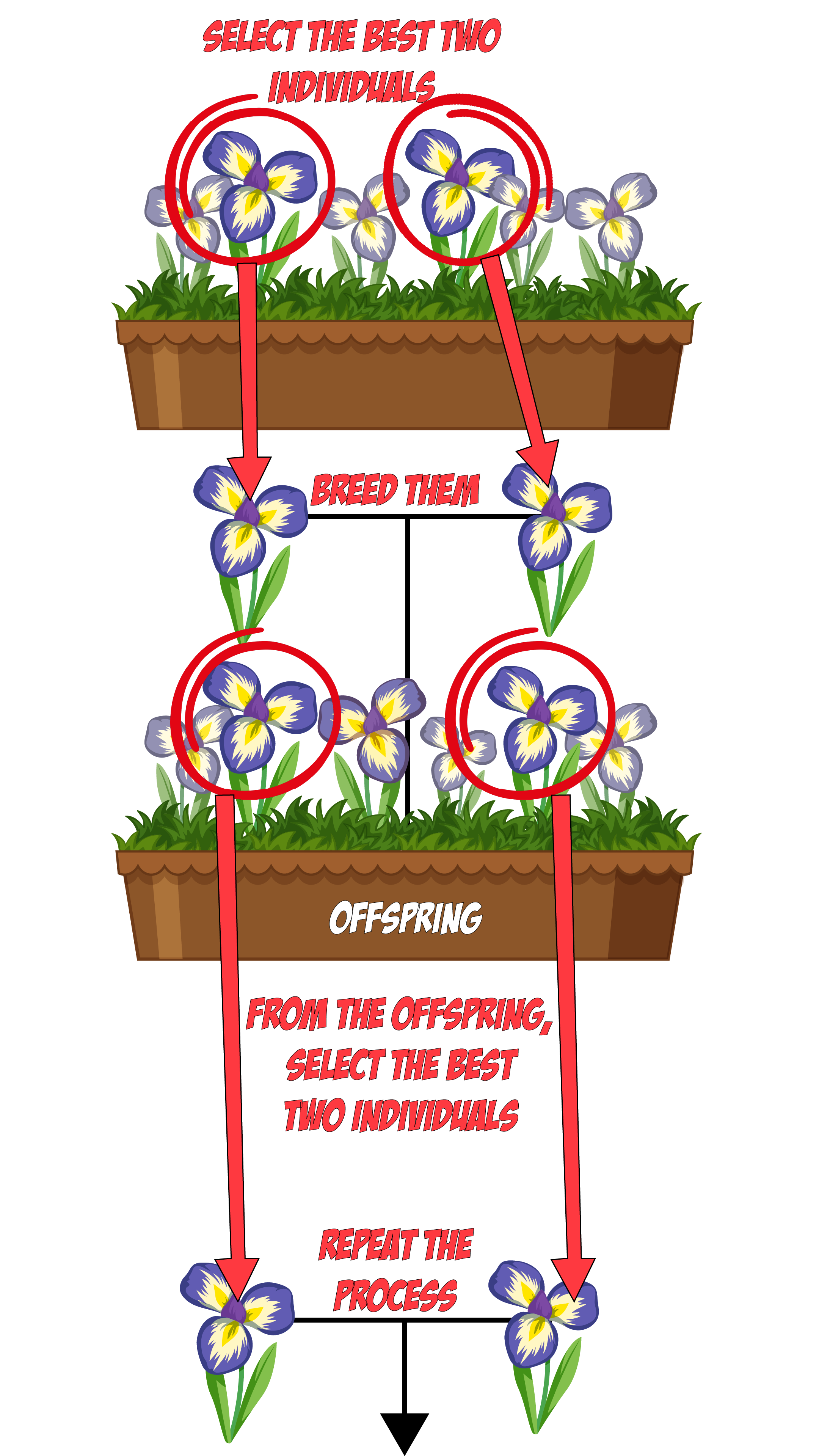
1) Start with the EXISTING STOCK and identify individuals with the DESIRED TRAITS.
2) These chosen individuals are then BRED to produce offspring.
3) From the OFFSPRING, select those that best show the desired traits and BREED them in the next generation.
4) Repeat this process across SEVERAL GENERATIONS, each time enhancing the trait in the population.
DOWNSIDES OF SELECTIVE BREEDING
A major drawback is the potential REDUCTION IN THE GENE POOL, leading to a decrease in genetic diversity.
The gene pool is the total number of DIFFERENT ALLELES present in a population.
The population of the selectively bred stock becomes INBRED as the humans chose two individuals which are CLOSELY RELATED.
INBREEDING can be problematic as
- It can result in increased HEALTH ISSUES and GENETIC DEFECTS.
- The lack of genetic variation can be dangerous if a new disease strikes. If one individual is not resistant to the disease, the WHOLE STOCK is also likely to NOT be RESISTANT to it as there's little to no variation within the closely related population. This means a new disease has the potential to KILL the WHOLE STOCK.